

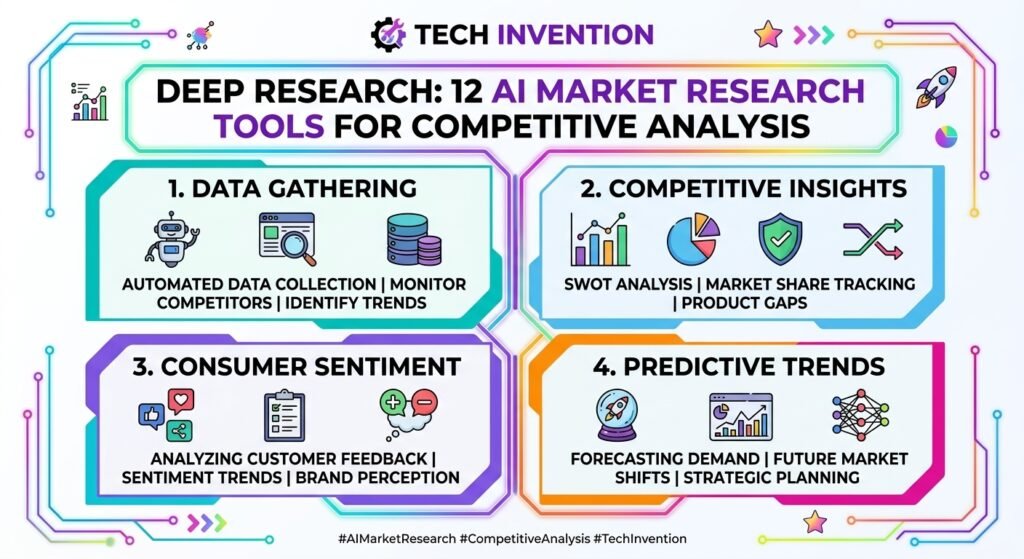
Looking for the best AI market research tools to understand your market and outsmart your competitors? The topic “AI Market Research Tools for Competitive Analysis” is becoming increasingly important for marketers, business owners, product teams, startups, and SEO professionals. It covers key areas such as consumer research, social listening, web data analysis, user behavior, and competitive intelligence.
Many businesses are now providing large amounts of data to AI systems, making it easier to process information and generate valuable insights. AI is transforming market research by helping businesses collect information faster, analyze large datasets, monitor competitors, understand customer behavior, identify market trends, and turn research into actionable business strategies.
Your reference article from Tech Invention highlights a range of tools focused on deep research and competitive intelligence, helping businesses make more informed, data-driven decisions.
Meta Title: 12 Best AI Market Research Tools for Competitive Analysis
Meta Description: Discover 12 AI market research tools for competitive analysis. See how AI analyzes competitors, market trends, and customer behavior faster!
What Is AI-Powered Market Research?
AI-powered market research uses artificial intelligence to collect, process, analyze, and summarize information about your market, competitors, and customers. It turns huge amounts of scattered data into clear, actionable insights—fast!
Specifically, AI-powered market research covers:
- Market trends
- Competitors
- Customers
- Consumer behavior
- Industry opportunities
- Search demand
- Brand sentiment
- Product performance
Competitive analysis is a focused type of market research. It zeroes in on understanding competitors’ strategies, strengths, weaknesses, marketing channels, positioning, and growth opportunities.
Why Use AI for Competitive Analysis?
AI makes competitive analysis faster, broader, and more continuous than manual research. Instead of spending days digging through competitor websites, you get source-backed insights in minutes—so you can make smarter, quicker decisions.
The biggest benefits of AI competitive analysis include:
- Speed: AI summarizes research, spots patterns, and analyzes data in a fraction of the time.
- Breadth: AI tracks search visibility, paid ads, backlinks, social conversations, and reviews all at once.
- Continuous monitoring: AI platforms watch for competitor changes around the clock, not just once a year.
It’s an easy, powerful way to keep your finger on the pulse of your market!
12 Best AI Market Research Tools
Here are 12 of the best AI market research tools to consider, along with what each one does best.
1. Kimi Deep Research
Kimi’s research capabilities focus on multi-source research, structured reports, comparative analysis, and citation-backed findings. The Kimi guide lists it as a tool for deep market and competitive research.
Best for: Researchers, marketers, analysts, and investors.
2. Perplexity
Perplexity supports multi-source research and structured research workflows. Its product use case also describes creating competitive maps and synthesizing user feedback.
Best for: Fast market research, research briefs, competitor discovery, and source-backed exploration. This tool has always helped me conduct detailed and meaningful research. Whenever I need reliable information or want to explore an important topic in depth, it saves me time and helps me find valuable insights quickly.
3. Semrush
Semrush provides competitive insights into competitor traffic, keywords, paid strategies, backlinks, and growth channels. Its current competitive analysis tools also show how brands and competitors appear across AI-driven search environments.
Best for: SEO, digital marketing, keyword gaps, traffic analysis, and AI visibility research. I mostly use Samerush because it provides me with the best results and makes my research easy.
4. Similarweb
Similarweb focuses on market size, market trends, competitor performance, audience behavior, and market shifts. Its competitive analysis offering is designed to help identify competitors and understand their growth strategies.
Best for: Digital market intelligence and competitor traffic analysis.
5. Crayon
Crayon is focused specifically on competitive intelligence. Its platform uses AI to organize competitive information and support sales and go-to-market teams with competitive insights and enablement.
Best for: Competitive monitoring, sales enablement, and battlecards.
6. Brandwatch
Brandwatch focuses on consumer intelligence and social listening. It uses AI to help organizations understand online conversations, consumer opinion, brand perception, and emerging trends.
Best for: Social listening, sentiment analysis, and consumer trend research.
7. Quantilope
Quantilope combines research automation, AI, and consumer research methodologies to generate faster customer insights from research and survey data.
Best for: Consumer research, surveys, product research, and customer insights.
8. Qualtrics
Qualtrics offers a market research platform covering market, product, innovation, UX, and brand research. Its positioning emphasizes combining research capabilities and insights across studies.
Best for: Enterprise market research and customer experience research.
9. AlphaSense
Our market research guide identifies AlphaSense as a tool for financial and enterprise intelligence, particularly for analyzing business documents and information sources.
Best for: Financial research, enterprise intelligence, investment research, and corporate analysis.
10. Hotjar
The Tech Invention guide includes Hotjar as a user behavior analytics tool for identifying UX issues through behavioral and feedback data.
Best for: Website research, customer behavior, UX analysis, and conversion optimization.
11. Atypica.AI
The Tech Invention guide categorizes Atypica.AI around automated market and customer analysis, including identifying patterns and competitor monitoring. Atypica.AI is an AI research agent that automatically builds personas, conducts interviews, and analyzes patterns to reveal the emotional and cognitive factors behind human choices.
Best for: Startups and marketing teams looking for automated research workflows.
12. Browse AI
Our informal guide lists Browse AI for web data extraction and turning website information into structured datasets that can support market tracking and growth research.
Best for: Web monitoring and structured competitive data collection.
The 5 Major Categories of AI Market Research Tools
AI market research tools fall into five main categories, each built for a different job. Use this table to quickly match your goal to the right type of tool!
| Category | Main Purpose | Example Tools |
|---|---|---|
| Deep Research | Multi-source research and reports | Kimi, Perplexity |
| Competitive Intelligence | Competitor monitoring | Crayon |
| SEO & Digital Intelligence | Traffic and keyword analysis | Semrush, Similarweb |
| Consumer Intelligence | Customer opinions and trends | Brandwatch, Quantilope |
| Research Platforms | Surveys and enterprise insights | Qualtrics |
How to Choose the Right AI Research Tool
There is no single “best” AI market research tool—the right choice depends on what you need most. Match the tool to your primary goal, and you’ll get far better results!
Here’s an easy way to decide:
- Choose deep research tools (Kimi, Perplexity) if you need multi-source reports and citation-backed findings.
- Choose competitive intelligence tools (Crayon) if you need continuous competitor monitoring and sales enablement.
- Choose SEO and digital intelligence tools (Semrush, Similarweb) if you need traffic, keyword, and AI-visibility analysis.
- Choose consumer intelligence tools (Brandwatch, Quantilope) if you need customer opinions, sentiment, and trends.
- Choose research platforms (Qualtrics) if you need surveys and enterprise-wide insights.
Key Insights for Choosing AI Research Tools
1. AI Makes Research Faster, But It Does Not Replace Verification
Here’s one important thing you shouldn’t overlook: AI can significantly speed up research, summarization, data analysis, and pattern identification, but that doesn’t mean you should rely on it completely. It’s important to verify AI-generated information using credible and reliable sources.
AI should support your research, not replace your own effort and critical thinking. When you combine AI tools with proper research and human analysis, you can achieve more accurate, deeper, and truly insightful results.
2. Competitive Analysis Is Expanding Beyond Websites
Modern competitive analysis increasingly includes:
- Search visibility
- Paid advertising
- Backlinks
- Social conversations
- Customer reviews
- Brand mentions
- AI search visibility
Semrush, for example, now includes competitor visibility within AI-driven answers as part of competitive research.
3. Continuous Monitoring Is More Valuable Than One-Time Research
Markets change constantly. A competitor can launch a new product, a pricing change, a marketing campaign, new content, or a new partnership at any time.
Continuous intelligence platforms help teams track these changes instead of performing competitor research only once a year. According to Crayon’s 2026 competitive intelligence research, dedicated CI platforms and AI now play a growing role in competitive workflows.
Frequently Asked Questions
1. What are AI market research tools?
AI market research tools use artificial intelligence to collect, analyze, and organize market data. They can help businesses understand customers, identify trends, monitor competitors, and make faster, data-driven decisions.
2. How can AI tools help with competitive analysis?
AI tools can analyze competitor websites, content, pricing, customer feedback, social media activity, and market trends. This helps businesses identify competitors’ strengths, weaknesses, opportunities, and potential threats.
3. What are the best AI market research tools for competitive analysis?
The best tool depends on your research needs. Popular options include tools for AI-powered research, social listening, competitor intelligence, keyword analysis, customer insights, and market trend discovery. The right choice should match your budget, industry, and research goals.
4. Can AI market research tools save time?
Yes. AI can automate many time-consuming research tasks, such as collecting information, summarizing reports, comparing competitors, identifying trends, and organizing large amounts of data.
5. Can small businesses use AI market research tools?
Absolutely. Small businesses can use AI research tools to understand their target audience, discover competitors, analyze market opportunities, and develop better marketing strategies without investing heavily in traditional research.
6. How accurate is AI-generated market research?
AI-generated research can be highly useful, but its accuracy depends on the quality and freshness of the data and sources. Important business decisions should be supported by checking original sources and verifying key findings.
7. Can AI tools identify market trends?
Yes. Many AI tools can analyze large amounts of online data to identify emerging topics, customer interests, industry trends, and changes in consumer behavior. This can help businesses respond to market changes earlier.
8. Can AI analyze customer feedback and reviews?
Yes. AI can analyze reviews, surveys, comments, and other customer feedback to identify common opinions, complaints, preferences, and sentiment. These insights can help businesses improve their products and customer experience.
9. Can AI tools monitor competitors?
Many competitive intelligence and social listening tools can track competitor activities, including content, brand mentions, product launches, pricing changes, and customer reactions. This makes it easier to keep up with changes in the competitive landscape.
10. Are AI market research tools better than traditional market research?
AI tools are not necessarily a replacement for traditional research. They are valuable because they can process information much faster and at scale. Combining AI-powered research with human analysis, interviews, surveys, and industry expertise can provide stronger insights.
11. What should I consider when choosing an AI market research tool?
Consider factors such as data sources, accuracy, real-time updates, competitor monitoring, AI capabilities, integrations, ease of use, reporting features, and pricing. Most importantly, choose a tool that provides the type of data you actually need.
12. How can businesses use AI market research insights effectively?
Businesses can use AI-generated insights to identify new opportunities, understand customers, improve products, analyze competitors, create marketing strategies, and make better business decisions. The key is to turn research findings into clear, actionable strategies rather than simply collecting data.
Final Thoughts
AI market research tools make it easier than ever to understand your market, track your competitors, and uncover customer insights—fast! The best tool for you simply depends on your goal, whether that’s deep research, competitor monitoring, customer insights, SEO intelligence, or enterprise research.
Pick the category that matches your needs, pair AI speed with human verification, and you’ll be making smarter, data-driven decisions in no time!