

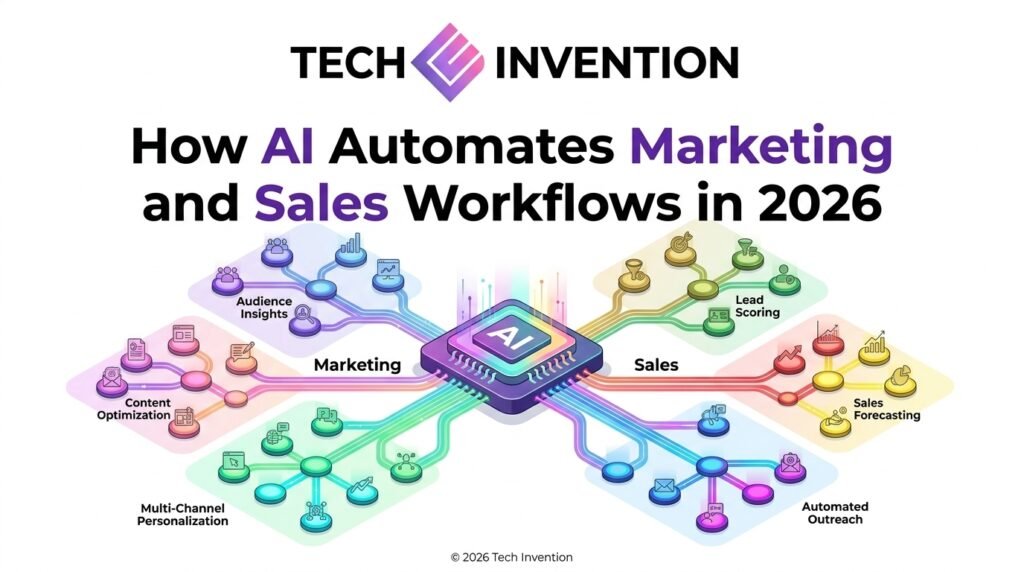
AI workflow automation uses artificial intelligence to run marketing and sales processes that once needed manual analysis and decisions. It segments audiences, scores leads, personalizes outreach, and updates your CRM automatically—so your team spends less time on busywork and more time closing deals and building relationships.
Let me be honest with you.
I’ve watched marketing and sales teams drown in repetitive work for years. Copying lead data into a CRM. Guessing which prospects are worth a call. Sending the same tired email to a list of thousands. It doesn’t have to be that way anymore.
AI marketing automation and AI sales automation have quietly changed how modern teams operate. And I’m not talking about basic “if-this-then-that” rules. I’m talking about systems that analyze, decide, and act—often before a human even logs in for the day.
In this guide, I’ll walk you through exactly how AI workflow automation works across your marketing and sales funnel. You’ll see real workflows, practical examples, and the benefits (and risks) you need to know. By the end, you’ll have a clear roadmap for putting AI to work in your own business.
Let’s dig in.
What Is AI Workflow Automation?
Here’s the simplest definition I can give you.
AI workflow automation is the use of artificial intelligence in marketing and sales to run processes that traditionally require human analysis, decisions, or repetitive work. It’s not just following rules—it’s making intelligent choices based on data.
A typical AI-powered workflow looks like this:
Customer Data → AI Analysis → Decision → Automated Action → Performance Analysis → Optimization
Let me show you a real example so it clicks.
Say a visitor downloads an eBook. Their information enters your CRM. From there, AI analyzes their company, behavior, and engagement. The lead gets a score. High-intent leads are routed automatically to a salesperson. AI then generates personalized follow-up messaging, the CRM logs every interaction, and the system recommends the next best action.
See the difference?
Traditional automation follows a fixed path. Intelligent automation thinks. That’s the leap we’re making right now—and it’s why so many teams are rebuilding their marketing automation workflows from the ground up.
How Does AI Automate Marketing Workflows?
Marketing is where a lot of teams see their first big wins with AI. Let me break down the four areas that matter most.
How Can AI Improve Customer Segmentation?
Traditional segmentation is slow. You manually split your audience by age, location, or a handful of behaviors—then hope you got it right.
AI customer segmentation flips that on its head.
AI can chew through massive datasets and spot patterns you’d never catch by hand. It segments audiences based on website behavior, purchase history, engagement levels, interests, location, lifecycle stage, conversion probability, product preferences, email interactions, and intent signals.
The result? More relevant campaigns for each group.
Salesforce, for example, documents AI personalization systems that use machine learning to deliver customized content and product recommendations based on customer context and behavior. That’s AI audience targeting working at a scale no human team could match.
Can AI Really Create Marketing Content?
Yes—and this is probably the most visible use of generative AI today.
AI content generation can assist with blog outlines, email campaigns, ad copy, social media posts, product descriptions, landing page copy, video scripts, subject lines, campaign briefs, and endless content variations.
But here’s the part people get wrong.
This does not mean you should publish everything automatically. AI content automation is best at accelerating the first draft. You and your team still handle strategy, fact-checking, creativity, and brand quality. Think of AI as your fastest junior copywriter—talented, quick, but always needing a human editor.
Salesforce documents AI capabilities for building campaign briefs and generating assets like email content, landing-page copy, and SMS messaging. That’s a huge head start on automated marketing campaigns.
How Does AI Make Email Marketing Smarter?
Blasting the same message to everyone is dead. Good riddance.
AI email marketing makes automation genuinely intelligent. Instead of one message for all, AI helps determine who should receive an email, when they should get it, which content is most relevant, which subject line will perform better, and what follow-up should happen next.
Picture this workflow:
A user visits your pricing page. AI identifies high purchase intent. A personalized email triggers instantly. Engagement gets analyzed. The follow-up sequence then adapts based on what the user actually does.
That’s predictive marketing in action.
IBM notes that AI marketing automation can use predictive analytics in marketing and customer behavior to automate decisions like audience segmentation, content recommendations, and email timing. Smarter timing alone can lift your open rates dramatically.
How Does AI Automate Sales Workflows?
Now let’s talk about the money side. This is where AI sales automation earns its keep.
How Does AI Handle Lead Generation?
Sales reps burn hours researching prospects. It’s necessary work—but it’s a terrible use of a closer’s time.
AI lead generation automates big chunks of it. AI can identify prospects based on your ideal customer profile (ICP), firmographic data, company size, industry, intent signals, website activity, and buyer behavior.
HubSpot’s AI sales prospecting guide describes AI sales prospecting workflows that automate lead identification, contact enrichment, outreach personalization, lead prioritization, and CRM handoffs. Your reps show up to a list that’s already warm.
What Is AI Lead Scoring and Why Does It Matter?
Not every lead is worth the same. You know this.
AI lead scoring analyzes historical conversion patterns and current buyer signals to rank your leads automatically. A lead might score high because they frequently visit product pages, request a demo, open multiple emails, work at a target company, match your ICP, or show strong buying intent.
Salesforce’s Einstein Lead Scoring uses machine learning to analyze conversion patterns and help teams prioritize leads that resemble past wins. HubSpot also offers AI lead qualification based on your existing customer and contact data.
The payoff is simple: your team spends time on leads that are actually likely to buy.
How Does AI Route Leads to the Right Rep?
Once AI flags a qualified lead, automation can route it to the right salesperson instantly.
Routing rules can weigh geographic region, product interest, company size, industry, rep availability, and account ownership.
HubSpot describes automated marketing-to-sales workflows where leads are scored, flagged as sales-ready, assigned to a rep, and dropped into follow-up sequences.
Here’s what it looks like:
Lead submits form → AI scores lead → Score exceeds threshold → CRM assigns salesperson → Personalized follow-up begins → Sales task created automatically.
No lead falls through the cracks. That’s the beauty of sales pipeline automation.
How Does AI Power Sales Outreach?
Cold outreach is hard. Writing 50 personalized emails a day? Exhausting.
AI sales outreach cuts the manual grind. It can help you create personalized cold emails, LinkedIn messages, follow-ups, call scripts, sales proposals, and meeting summaries.
The magic happens when you combine automation with personalization.
Instead of sending a lifeless “Hi, I’d like to introduce our services,” an AI sales assistant can weave in real context—the prospect’s role, company, industry, or specific pain points.
HubSpot describes AI sales workflows that spot buying signals, prioritize prospects, personalize outreach, and automate follow-ups across every stage of the funnel. That’s how you scale relevance without sounding like a robot.
How Does AI Improve CRM Automation?
Your CRM is the heart of your operation. AI makes it a lot smarter.
AI CRM automation can handle contact data entry, AI prospect enrichment, activity logging, lead scoring, deal prioritization, follow-up reminders, opportunity insights, forecasting, and segmentation.
All that repetitive admin work? Gone.
A strong AI-powered CRM workflow flows like this:
New Lead → Data Enrichment → AI Scoring → Segmentation → Lead Assignment → Personalized Outreach → Engagement Tracking → Sales Follow-Up → Conversion Analysis
The best part is what it does for teamwork. Shared data and automatic handoffs create real marketing and sales alignment—no more finger-pointing over who dropped the ball.
How Does AI Automate the Full Customer Journey?
AI doesn’t just help in one spot. It works across the entire customer lifecycle automation process.
- Awareness: AI analyzes audiences, creates content, and identifies potential customers.
- Consideration: AI personalizes content, recommends products, and nurtures leads with automated lead nurturing.
- Conversion: AI scores leads, prioritizes opportunities, and triggers sales actions.
- Retention: AI spots disengaged customers and fires off retention campaigns.
- Expansion: AI surfaces upselling, cross-selling, and renewal opportunities.
Salesforce’s personalization tools describe machine-learning approaches that use customer context to support personalized recommendations and next-best offer decisions. That’s revenue you’d otherwise leave on the table.
What Are AI Agents and the Future of Automation?
Here’s where things get exciting.
The next stage is agentic AI.
Traditional automation follows: Trigger → Rule → Action.
AI agents for business follow: Trigger → Analyze → Decide → Act.
See the extra steps? That’s intelligence baked in.
AI agents can potentially manage multi-step workflows—analyzing campaign performance, spotting underperforming segments, suggesting new messaging, generating campaign variations, preparing recommendations for human approval, monitoring results, and recommending further optimization.
McKinsey’s 2026 analysis describes marketing as increasingly becoming a continuous, AI-enabled system that connects insights, content, commerce, and performance. That’s the direction we’re all heading. Autonomous business workflows are coming fast.
Practical AI Marketing and Sales Workflow Examples
Enough theory. Let me give you four workflows you can model right now.
Workflow 1: AI Lead Generation
Website visitor → Form submission → CRM → AI enrichment → Lead scoring → Sales assignment
Benefits: Faster lead processing, less manual research, better prioritization.
Workflow 2: AI Email Nurturing
Lead downloads content → AI analyzes interest → Personalized email sequence → Engagement tracking → Sales handoff
Benefits: Better personalization, automated follow-ups, tighter marketing-to-sales coordination.
Workflow 3: AI Sales Follow-Up
Sales meeting → AI meeting summary → CRM updated → Follow-up email drafted → Task scheduled
Benefits: Less admin work, faster follow-up, cleaner CRM data.
Workflow 4: AI Customer Retention
Customer activity drops → AI detects churn risk → Retention campaign triggered → Personalized offer delivered
Benefits: Earlier intervention, stronger retention, automated AI-driven customer engagement.
What Are the Benefits of AI Marketing and Sales Automation?
Let me sum up why this matters. Here are the seven benefits I see most often:
- Increased productivity. AI slashes repetitive admin tasks.
- Faster lead response. High-intent leads get identified and routed instantly.
- Better personalization. AI personalizes messaging at massive scale.
- Improved lead prioritization. Reps focus on the promising opportunities.
- Better data analysis. AI processes patterns across huge datasets.
- Improved customer experience. Customers get relevant messages and offers.
- Better marketing-sales alignment. Shared data and automated handoffs kill friction.
Put simply: you do more with less.
What Challenges Should You Watch Out For?
I won’t sugarcoat it. AI automation isn’t a “set it and forget it” machine.
You need to keep an eye on data quality, privacy, security, AI hallucinations, brand consistency, bias, and compliance. And you always need human review.
Here’s a truth worth tattooing on the wall: poor customer data produces poor AI recommendations. Garbage in, garbage out.
So what’s the winning strategy?
Automate the repetitive work. But keep humans firmly responsible for strategy, relationships, brand decisions, and high-impact calls. AI is your co-pilot—not your replacement.
Ready to Put AI to Work?
Here’s your step-by-step starting point.
First, audit your current marketing workflow automation and find the repetitive tasks eating your team’s time. Next, clean up your customer data—AI is only as good as what you feed it. Then, pick one workflow (lead scoring is a great first win) and automate it. Finally, measure results, review the output with a human eye, and expand from there.
The teams pulling ahead in 2026 aren’t the ones with the biggest headcount. They’re the ones using AI-powered marketing and AI-powered sales to move faster, personalize deeper, and close smarter.
Don’t wait until your competitors have already automated the funnel. Start small, stay in control, and let AI handle the busywork so you can focus on what humans do best—building relationships and closing deals.
Your future funnel is intelligent. Time to build it.
Frequently Asked Questions
What is AI workflow automation in marketing and sales?
AI workflow automation uses artificial intelligence to run marketing and sales processes that once needed manual work—like segmenting audiences, scoring leads, personalizing outreach, and updating your CRM. Unlike basic rule-based automation, it analyzes data and makes decisions on its own.
How much does AI marketing and sales automation cost?
Costs vary widely depending on the tools and scope. Many platforms like HubSpot and Salesforce offer tiered plans, from affordable starter tiers for small teams to enterprise packages. Start with one workflow, prove the ROI, then scale your investment as results come in.
Is AI going to replace marketing and sales jobs?
No, AI handles repetitive tasks like data entry, lead scoring, and first-draft content. Humans remain responsible for strategy, creativity, relationships, and high-impact decisions. The best results come from pairing AI automation with human judgment—not replacing people entirely.
What’s the best first workflow to automate with AI?
The best first workflow to automate with AI is usually a repetitive, time-consuming task that follows a clear process, such as lead generation, customer inquiries, email responses, content creation, or data entry.
Example: Instead of manually researching competitors every week, AI can collect competitor data, summarize key changes, identify trends, and create a research report for you.
Start with one simple workflow, measure the time it saves, and then gradually automate more complex tasks.
What are the biggest risks of AI sales:?
The main risks are poor data quality, privacy, and trust. It uses your existing customer data, requires little setup, and immediately helps your sales team focus on the leads most likely to convert. From there, expand into email nurturing and CRM automation.
Security gaps, AI hallucinations, bias, and brand inconsistency. Always keep a human in the loop for review, and remember that clean, accurate customer data is the foundation of reliable AI recommendations.