

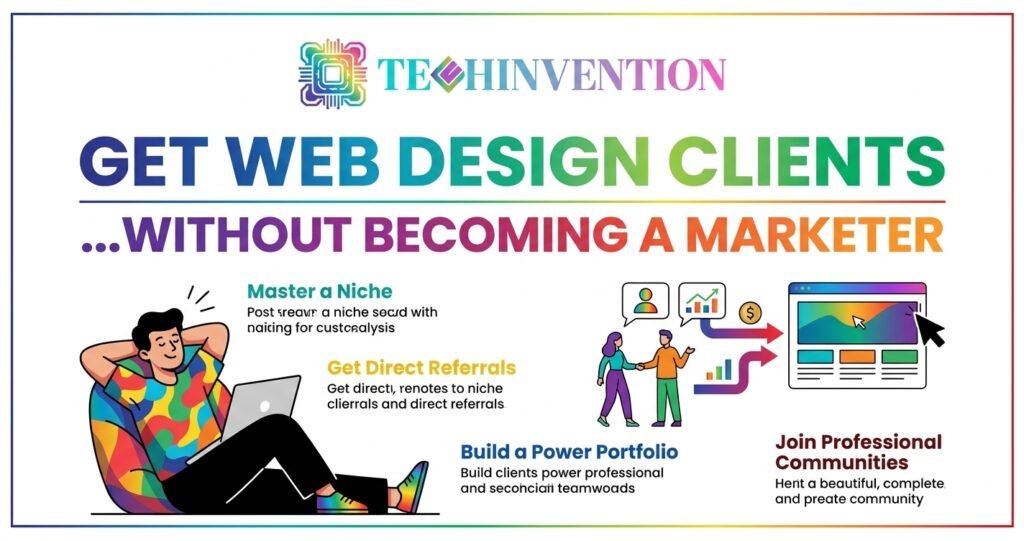
If you’re tired of hearing that the only way to grow your web design business is to post on every platform, dance for the algorithm, or send 100 awkward DMs a day, I get it. I’ve seen too many talented designers assume they’re bad at business when the real issue is simpler: they’re using the wrong client acquisition strategies. The truth is, how to get web design clients is not really about becoming louder. It’s about becoming clearer, more credible, and easier to hire. That’s a huge difference.
In this guide, I’ll walk you through a step-by-step system for attracting web design clients without turning yourself into a full-time marketer. You’ll learn how to position your offer, build trust fast, create better web design leads, and use low-friction outreach that feels human. Even better, these approaches line up with Google’s advice on building helpful, user-first web experiences and content, which matters if you want long-term visibility online.
Why Most Web Designers Struggle to Get Clients
Here’s the part nobody says clearly enough: many freelancers don’t have a lead problem. They have a positioning problem. When your site says you do “websites for everyone,” your offer becomes forgettable. When your portfolio shows pretty layouts but no outcomes, potential web design clients hesitate. And when your outreach sounds generic, even good-fit prospects ignore it.
That’s why finding web design clients gets dramatically easier when you stop trying to look like a generalist who can do anything for anyone. Several current guides on winning clients emphasize the same core themes: build a credible presence, lean into referrals, specialize when possible, and make your offer specific enough to feel useful immediately.65 In other words, you do not need more promotion. You need sharper relevance.
The Best Mindset Shift: Stop Marketing, Start Reducing Risk
If you remember one idea from this article, let it be this: clients don’t buy web design because they love web design. They buy because they want a better business result with less risk. That means your job is not to “market harder.” Your job is to make the hiring decision feel safe.
So instead of asking, “How do I get more attention?” ask, “How do I help potential freelance web design clients trust me faster?” That shift changes everything. Suddenly, your web design portfolio, your client testimonials, your website redesign portfolio, and your outreach all have one purpose: reducing uncertainty. And once you reduce uncertainty, attracting web design clients becomes much more natural.
Step 1: Pick a Clear Web Design Niche
Choosing a web design niche is one of the fastest ways to improve web design client acquisition. Why? Because specialists are easier to understand, easier to refer, and easier to trust. If I say I help local law firms improve consultation bookings with conversion-focused web design, that instantly feels more valuable than saying I build websites for anyone with a budget.
This doesn’t mean you must lock yourself into one tiny corner forever. It simply means you need a strong starting position. You might focus on local business web design, small business website design, ecommerce web design, WordPress web design, or industry-specific web design for service businesses. Niche specialization is consistently recommended because it simplifies messaging and makes client decisions easier.65
How to Choose a Niche That Actually Pays
Start with overlap. Look for the place where your skills, market demand, and proof can meet. Ask yourself:
- Which industries do I already understand?
- Which type of site do I build best?
- Which clients get the clearest ROI from better design?
- Which projects could turn into repeat referrals?
If you can answer those questions, you’re already on your way to becoming a niche web designer with specialized web design services instead of just another generalist.
Step 2: Turn Your Portfolio Into a Trust Engine
A lot of designers have a portfolio. Far fewer have a portfolio that sells. A great professional web designer portfolio does more than show visuals. It proves business value. That means your best examples should show context, challenges, solutions, and outcomes. If possible, include before and after website design, conversion improvements, SEO gains, bounce-rate changes, or lead-quality improvements.
Think of your web design case studies as your silent sales team. They help you demonstrate web design skills without bragging. They also create the social proof that skeptical buyers need before they reach out. Even if you’re newer, you can still build smart examples by redesigning a weak site conceptually, showing your thinking, and explaining the strategy behind the design. That helps you build credibility online much faster than simply posting screenshots.
What to Include in High-Converting Case Studies
Use this simple format:
- The client or business type
- The problem with the old site
- Your strategy
- Key design and UX decisions
- Results or expected impact
- A short testimonial, if available
That structure makes your website design examples feel useful instead of decorative.
Step 3: Create an Offer That Solves One Expensive Problem
The easiest way to get more qualified web design leads is to package your service around a painful, costly problem. Businesses don’t wake up saying, “I want a modern hero section.” They say, “My site looks outdated,” “I’m not getting inquiries,” or “People leave too quickly on mobile.” That’s your entry point.
So instead of selling generic web design services, sell a focused result. For example:
- Website redesigns for local service companies with outdated sites
- Responsive website design for businesses losing mobile leads
- Conversion-focused web design for firms with traffic but low inquiries
- WordPress web design retainers for small businesses that need speed and simplicity
This approach also aligns with Google’s emphasis on useful, accessible, mobile-friendly websites built for people first.12
Step 4: Use Free Website Audits as a Soft-Sell Lead Magnet
One of the best ways to start getting clients without cold calling is to offer a focused free website audit. Not a giant 40-page document. Not a vague “your site could improve.” I mean a short, personalized teardown that points out a few clear issues and explains what they may be costing the business.
This works because it proves expertise before asking for trust. It also gives you a natural reason to contact potential web design clients without sounding pushy. Current client-acquisition advice for web designers frequently highlights audits, niche-specific insights, and targeted recommendations as practical openers because they create immediate value.
What to Include in a Simple Audit
Keep it practical:
- One issue with messaging
- One issue with design clarity
- One issue with mobile usability
- One issue with speed, trust, or SEO
- One quick win they could implement now
That’s enough to start a conversation and generate better web design leads.
Step 5: Reach Out Personally, Not Like a Marketer
Let’s talk about personalized outreach. Most bad outreach fails because it’s lazy. It sounds copied, self-centered, and vague. Good outreach feels observant. It shows you actually looked at the business. If you want more direct clients for web designers, this matters a lot.
A strong cold email for web designers can be short and still work well. Mention one specific thing you noticed, connect it to a likely business impact, and offer one useful next step. That’s it. No fake urgency. No giant pitch deck. No “just circling back” energy.
A Simple Outreach Structure
Use this framework:
- Personalized opener
- One issue you noticed
- Why it may matter
- A quick suggestion
- Small CTA
Example CTA: “If you want, I can send over a quick 3-point audit.”
That approach supports getting clients without marketing in the traditional noisy sense, because you’re leading with relevance instead of hype.
Step 6: Build a Referral System That Runs Quietly in the Background
Referrals are still one of the highest-leverage ways to get freelance web design clients. In fact, several current sources stress that a credible presence plus referrals and networking remain core growth channels for designers. The key is not waiting passively. You need a real client referral strategy.
At the end of a successful project, ask for two things: a testimonial and an introduction. Make it easy. Be specific. Say who you help best. For example, “If you know another accounting firm with an outdated site, I’d love an intro.” That sentence is much stronger than “Let me know if you know anyone.”
Referral Assets to Prepare
Have these ready:
- A one-sentence positioning statement
- A short portfolio link
- Two strong client testimonials
- One niche case study
That makes your referral marketing cleaner and much more repeatable.
Step 7: Prospect Locally With Smarter Filters
If you want local business clients, local prospecting can still work extremely well. One underrated tactic is Google Maps prospecting. Look for businesses with weak websites, no clear calls to action, outdated branding, poor mobile experience, or inconsistent trust signals. Then group them by niche, so your messaging stays relevant.
This works especially well for B2B web design clients and service-based businesses where the website directly supports calls, bookings, or quote requests. Instead of blasting hundreds of contacts, build a short list of high-fit companies. A smaller list with better personalization usually beats a giant list with generic messaging every time.
Step 8: Let SEO Bring You Clients While You Sleep
Yes, you can absolutely use SEO for web designers without becoming a content machine. The trick is to publish a handful of highly useful, intent-driven pages. Google’s documentation repeatedly emphasizes helpful, crawlable, user-focused content and technically sound websites.12 That is good news for web designers, because you already understand site structure, UX, speed, mobile design, and trust.
Create pages like:
- Web design for dentists in your city
- Website redesign for law firms
- Small business website design pricing guide
- Common homepage mistakes for local service businesses
This is content marketing for web designers at its smartest: focused, useful, and tied directly to buyer intent.
Secondary Keywords You Should Naturally Work In
As you create pages and articles, weave in terms like finding freelance clients, qualified web design leads, web design lead generation, and professional web designer portfolio. Don’t stuff them. Use them naturally where they help the reader.
Step 9: Make Your Own Website Practice What You Preach
Your site is either helping you get clients or quietly costing you clients. There’s rarely an in-between. If your own site loads slowly, has weak messaging, or hides your best work, you’re creating friction. That’s especially damaging when prospects are already comparing multiple designers.
At minimum, your site should clearly say who you help, what result you deliver, and what the next step is. It should also include social proof, examples of responsive website design, and an easy path to contact you. If you want to convince clients to invest, your own website must function as proof that your process works.
Step 10: Network Like a Specialist, Not a Salesperson
Good networking for web designers doesn’t mean collecting random contacts. It means becoming memorable in a specific category. Join local business communities, founder groups, niche Slack spaces, or regional events where your ideal buyer already spends time. Then contribute useful insight. Don’t force the pitch.
When people associate you with one outcome, referrals become easier. For example, if you become “the designer who helps local clinics fix confusing websites,” your name sticks. That’s how quiet authority compounds over time.
Step 11: Sell the Outcome, Not the Website
If you want more conversions from proposals and calls, stop centering the deliverable. Center the business result. A website is the tool. The outcome is more leads, better trust, stronger bookings, easier sales conversations, and a more credible brand.
So when you present your offer, connect every feature to value. Faster load times support retention. Better messaging supports conversion. Cleaner structure supports SEO. Better UX supports trust. When clients see the logic, buying feels rational. And when buying feels rational, it becomes easier to confidently choose your service over cheaper alternatives.
Frequently Asked Questions: Getting Web Design Clients Without Marketing
- Do I really need a marketing strategy or sales funnel to land web design clients?
No. Instead of running complex funnels or paid ad campaigns, you can leverage direct relationships, strategic partnerships, and organic referrals to build a consistent pipeline of freelance clients.- What is the most reliable way to get web design clients without self-promoting?
Strategic partnerships with digital marketing agencies, SEO specialists, and copywriters are the most reliable source. They frequently require white-label web designers or need to offload website builds to someone they trust.- How can I get web design clients through referrals?
Deliver exceptional technical and visual quality to your current clients, set clear launch timelines, and ask for referrals directly upon completing a project. Offering a referral incentive or discount on future maintenance plans can also prompt quick recommendations.- Is cold pitching effective for web designers who hate sales?
Cold pitching works best when targeted and value-driven rather than mass-emailed. Pick 5 to 10 local businesses with outdated or broken mobile layouts, record a quick 2-minute video highlight of quick fixes, and send it directly to the owner.- How can I use freelancing platforms like Upwork or Fiverr without competing in a race to the bottom?
Optimize your profile around a specific niche (e.g., WooCommerce setups for luxury apparel or high-converting WordPress landing pages for SaaS). Clients pay higher rates when you position yourself as a specialized problem solver rather than a generalist web designer.- What role does a portfolio play if I am not actively marketing my services?
Your portfolio acts as your silent salesperson. Focus on case studies that highlight performance improvements (e.g., faster load times, increased conversion rates, mobile responsiveness) rather than just static screenshots of your designs.- How do I find high-paying web design clients locally?
Attend non-marketing networking events, such as local business association meetups or niche industry conferences. Position yourself as the technical advisor who helps local business owners solve web infrastructure and performance issues.- Should I niche down to get web design clients faster?
Yes. Specializing in a particular platform (WordPress, Shopify, Webflow) or industry (dentists, real estate, e-commerce stores) makes it easier for potential clients and agency partners to remember and refer you.- How can I keep a steady flow of income without constantly searching for new clients?
Offer monthly website care packages, hosting maintenance, and technical updates to existing clients. This creates recurring monthly revenue and keeps you top-of-mind whenever they need a site rebuild or feature expansion.- What is the best way to leverage LinkedIn without creating daily content?
Keep your profile fully optimized to read as a solution provider rather than a resume. Engage meaningfully in comment threads of agency owners, marketing directors, and business owners who frequently post about web development needs.- How do I deal with client acquisition drought periods?
Re-engage past clients with a quick website audit or performance checkup. Informing them of outdated plugins, broken links, or speed bottlenecks often leads to new redesign contracts or ongoing maintenance work. - Can open-source contributions or community engagement bring in freelance clients?
Yes. Participating in WordPress forums, answering technical questions on Reddit, or helping out in developer Slack groups builds authority organically. People seeking help with technical issues frequently hire the experts answering their questions.
Final Thoughts: You Do Not Need to Become a Marketer
You do not need to post endlessly, chase trends, or become someone you’re not to win better web design clients. You need a clear niche, a stronger trust system, a useful offer, and a few reliable acquisition channels. That’s the real answer to how to get web design clients without becoming a marketer.
If I were starting today, I’d do this in order: pick a niche, tighten my web design portfolio, publish two trust-building case studies, create a short free website audit offer, and send personalized outreach to a small list of high-fit businesses. Then I’d ask every happy client for referrals and keep improving my own site’s SEO. Simple. Calm. Effective.
And if you offer the right solution to the right business at the right time, you won’t need to beg for attention. Your work will do the selling for you.