

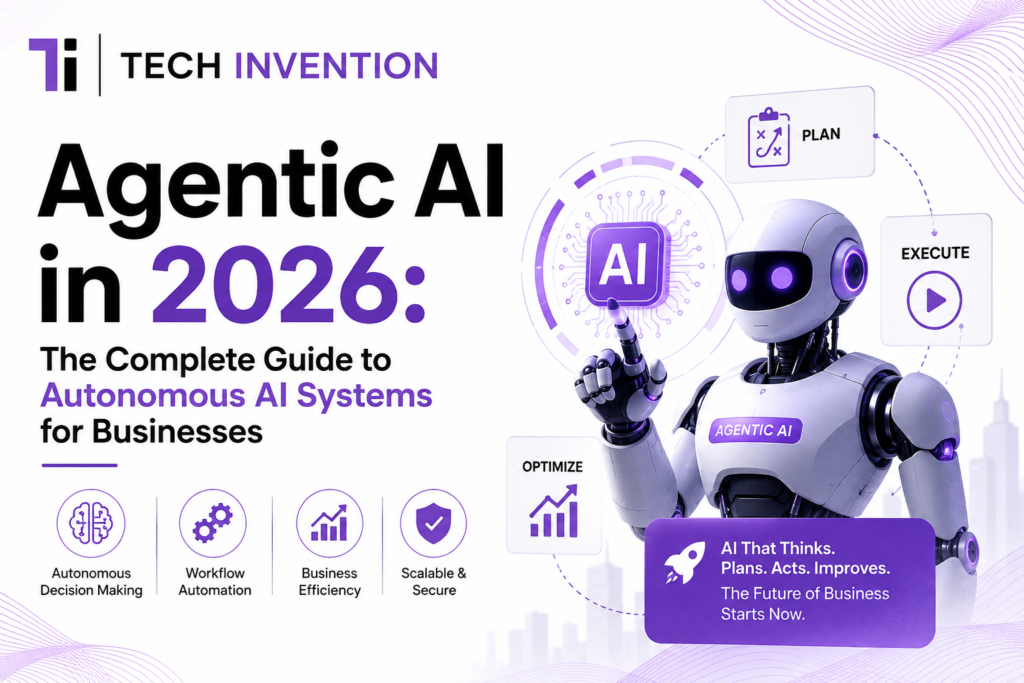
Artificial intelligence has moved past the era of simple chatbots and content generators. In 2026, businesses are adopting a new class of technology that doesn’t just respond to prompts — it thinks, plans, and acts on its own. This is Agentic AI, and it is quickly becoming the backbone of modern enterprise automation.
In this guide, we’ll break down what Agentic AI actually is, how it works, where it’s already being used, and why every forward-thinking business should have a strategy for it before competitors get there first.
What is Agentic AI?
Definition of Agentic AI
Agentic AI refers to artificial intelligence systems designed to act as autonomous “agents.” Instead of waiting for a single instruction and producing a single output, these systems can understand a goal, break it into steps, use external tools, and carry out multi-stage tasks with little to no human intervention along the way.
Think of the difference between an assistant who answers a question when asked, versus one who is handed a project, figures out the steps required, executes them, checks the results, and adjusts course when something goes wrong. That second scenario is what Agentic AI brings to the table.
Why Agentic AI Matters in 2026
By 2026, the conversation around AI has shifted from “what can AI generate?” to “what can AI actually do for my business?” Rising labor costs, growing customer expectations for instant service, and the sheer volume of repetitive digital work have pushed companies to look for systems that can operate independently, at scale, around the clock.
Agentic AI matters because it closes the gap between AI-generated suggestions and AI-executed outcomes — turning artificial intelligence from an assistant into an active member of the workforce.
How Agentic AI Works
Agentic AI systems generally follow a cycle made up of the following stages:
| Stage | What Happens |
|---|---|
| Goal Understanding | The system interprets the objective given by a user or business process, clarifying intent and constraints. |
| Planning Multiple Tasks | It breaks the goal into smaller, ordered tasks or sub-goals needed to reach the outcome. |
| Using External Tools | The agent connects to APIs, databases, software, or the web to gather information or perform actions. |
| Learning from Results | After each action, the system evaluates whether the outcome matches the intended goal. |
| Continuous Improvement | Feedback loops help the agent refine its approach for future tasks, improving accuracy and efficiency over time. |
This loop — understand, plan, act, evaluate, improve — is what separates Agentic AI from traditional automation scripts, which can only follow pre-programmed instructions without adapting to new situations.
Agentic AI vs Generative AI
Key Differences
Generative AI and Agentic AI are often mentioned together, but they solve different problems.
| Aspect | Generative AI | Agentic AI |
|---|---|---|
| Core Function | Creates content (text, images, code) from prompts | Plans and executes multi-step tasks toward a goal |
| Autonomy | Requires a prompt for every output | Can operate independently across a workflow |
| Tool Use | Limited or none | Actively integrates with external tools and systems |
| Decision Making | Doesn’t make ongoing decisions | Makes sequential decisions based on results |
| Best Fit For | Drafting content, summarizing, brainstorming | Automating processes, running workflows, executing tasks |
Which One is Better?
Neither is inherently “better” — they serve different purposes. Generative AI excels at producing content quickly. Agentic AI excels at getting things done. Most mature AI strategies in 2026 use both together: generative models handle content and reasoning, while agentic layers handle execution and orchestration.
Real-world Comparison
A generative AI tool might write a customer follow-up email when asked. An agentic AI system, on the other hand, would notice that a lead has gone cold, decide a follow-up is needed, draft the email, send it, monitor for a response, and escalate to a sales rep if there’s no reply within 48 hours — all without a human triggering each step.
Benefits of Agentic AI
Increased Productivity
By handling repetitive, multi-step processes independently, Agentic AI frees employees to focus on strategic, creative, and relationship-driven work.
Lower Operational Costs
Automating workflows that previously required manual coordination across teams reduces overhead, staffing needs, and the cost of human error.
Better Decision Making
Agentic systems can process large volumes of data far faster than humans, surfacing insights and recommending — or even making — decisions grounded in real-time information.
24/7 Automation
Unlike human teams, AI agents don’t need breaks, shifts, or time zones. They can monitor systems and respond to events at any hour.
Faster Customer Service
Agentic AI can resolve support tickets, process refunds, update accounts, and escalate complex issues instantly, dramatically cutting response times.
Top Agentic AI Use Cases in 2026
| Industry/Function | Example Use Case |
|---|---|
| Healthcare | AI agents managing patient scheduling, insurance verification, and follow-up reminders |
| Finance | Autonomous fraud detection and real-time transaction monitoring |
| Customer Support | AI agents resolving tickets end-to-end without human handoff |
| Manufacturing | Predictive maintenance agents that schedule repairs before failures occur |
| Marketing | Agents that plan, launch, and optimize ad campaigns automatically |
| Software Development | Coding agents that write, test, and debug code with minimal oversight |
| Cybersecurity | Agents that detect threats and initiate containment protocols instantly |
| Education | Personalized learning agents that adapt coursework to student performance |
| E-commerce | Agents managing inventory, pricing, and personalized product recommendations |
| HR Automation | AI agents handling candidate screening, interview scheduling, and onboarding |
These use cases show that Agentic AI isn’t a single-industry trend — it’s a horizontal shift affecting nearly every function inside a modern business.
Industries Using Agentic AI
| Industry | How Agentic AI is Applied |
|---|---|
| Banking | Automated compliance checks, fraud monitoring, and loan processing |
| Retail | Dynamic pricing, demand forecasting, and personalized shopping agents |
| Logistics | Route optimization and autonomous supply chain coordination |
| Healthcare | Administrative automation and patient engagement |
| SaaS | In-app AI agents that guide onboarding and reduce churn |
| Government | Citizen service agents and automated case processing |
| Education | Adaptive tutoring systems and administrative automation |
| Insurance | Claims processing agents and risk assessment automation |
Challenges of Agentic AI
Despite its promise, Agentic AI isn’t without risk. Businesses need to weigh these challenges carefully before deployment.
Security Risks
Because agents can take real actions — not just generate text — a flawed or manipulated agent could cause real operational damage, from incorrect transactions to unauthorized system access.
Data Privacy
Agentic AI systems often need access to sensitive business and customer data to function effectively, raising the stakes for how that data is stored, processed, and protected.
Ethical Concerns
Autonomous decision-making raises questions about accountability: who is responsible when an AI agent makes a costly or harmful mistake?
Human Oversight
Even the most capable agentic systems benefit from human-in-the-loop checkpoints, especially for high-stakes decisions like financial transactions or medical recommendations.
Compliance
Regulatory frameworks are still catching up to autonomous AI systems, meaning businesses must stay proactive about governance, auditability, and industry-specific compliance requirements.
AI Employees
Some organizations are beginning to treat AI agents like digital team members — assigning them ongoing responsibilities, performance metrics, and even “onboarding” processes.
Multi-Agent Systems
Rather than a single agent handling everything, businesses are increasingly deploying networks of specialized agents that collaborate, each handling a distinct part of a larger workflow.
AI Decision Networks
Interconnected agents are starting to form decision networks capable of coordinating across departments — marketing agents informing sales agents, which inform finance agents, and so on.
Enterprise Transformation
As these systems mature, Agentic AI is expected to become a core layer of enterprise infrastructure, much like cloud computing did over the past decade — not an optional add-on, but a foundational capability.
Build Smart AI Solutions with Tech Invention
At Tech Invention, we help businesses adopt the latest AI technologies to automate workflows, improve productivity, and accelerate digital transformation. Whether you’re planning an AI-powered chatbot, autonomous workflow automation, custom web application, or enterprise AI integration, our experienced team delivers secure, scalable, and future-ready solutions tailored to your business goals.
Our AI & Digital Services:
- AI Software Development
- Custom AI Agents
- Business Process Automation
- Website Development
- Mobile App Development
- SEO Services
- Digital Marketing
- Cloud Solutions
- UI/UX Design
- AI Consulting
Ready to Transform Your Business with Agentic AI?
Don’t let your competitors gain the AI advantage first.
Partner with Tech Invention to build intelligent AI solutions that automate operations, reduce costs, and drive business growth.
Contact us today for a free consultation and discover how Agentic AI can revolutionize your business.
Tech Invention – Building Smarter Businesses with AI.
Frequently Asked Questions
What is Agentic AI?
Agentic AI is an advanced form of artificial intelligence that can plan, reason, use tools, and complete multi-step tasks with minimal human intervention.
How is Agentic AI different from Generative AI?
Generative AI creates content based on prompts, while Agentic AI can independently execute tasks, make decisions, and achieve goals.
What industries benefit most from Agentic AI?
Healthcare, finance, retail, manufacturing, education, logistics, cybersecurity, and customer service are among the biggest beneficiaries.
Is Agentic AI safe for businesses? Yes, when implemented with proper governance, security controls, human oversight, and compliance policies.
Can small businesses use Agentic AI?
Absolutely. Small businesses can automate customer support, marketing, sales, scheduling, invoicing, and internal workflows using AI agents.
What are examples of Agentic AI?
Examples include AI customer support agents, autonomous coding assistants, AI research agents, workflow automation systems, and AI sales assistants.
What are the biggest challenges of Agentic AI?
The main challenges include data privacy, AI governance, transparency, cybersecurity risks, and ensuring appropriate human oversight.
Will Agentic AI replace jobs?
Rather than replacing all jobs, Agentic AI is expected to automate repetitive work and allow employees to focus on higher-value strategic tasks.
How can businesses prepare for Agentic AI?
Businesses should identify automation opportunities, establish AI governance policies, invest in employee training, and work with experienced AI implementation partners.
Why choose Tech Invention for AI development?
Tech Invention offers custom AI development, intelligent automation, SEO, web development, mobile applications, and digital transformation services to help businesses successfully adopt AI technologies.