

What Is a Marketing Funnel?
A marketing funnel (sometimes called a conversion funnel or sales funnel) is the path a potential customer takes from first discovering your brand to making a purchase—and ideally, coming back for more.
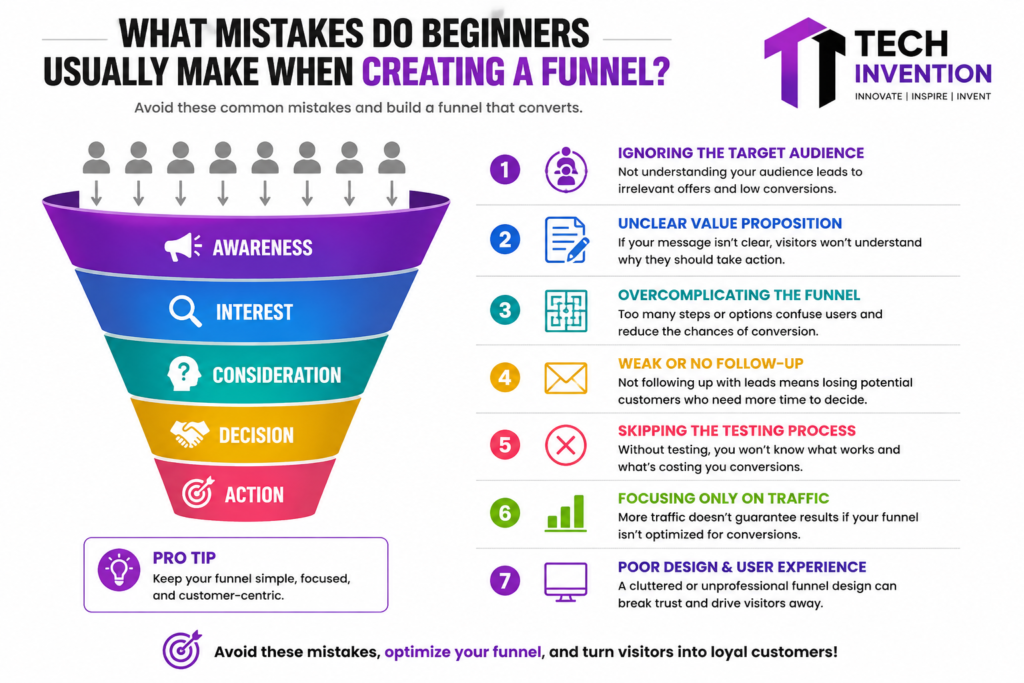
It’s typically broken into three core stages:
- Awareness stage: The prospect learns you exist.
- Consideration stage: They evaluate whether you’re the right fit.
- Decision stage: They convert—or don’t.
Beyond the sale, a well-built funnel also accounts for retention, upselling, and cross-selling. Think of it less like a straight line and more like a series of micro-commitments, each one moving the prospect closer to becoming a loyal customer.
Understanding this structure is step one. The mistakes happen when beginners skip steps, rush the process, or optimize the wrong things entirely.
Why Do Beginner Funnels Fail?
Most beginner funnels don’t fail because the offer is bad.
They fail because the structure is bad.
Common culprits include unclear messaging, mismatched audiences, ignored mobile users, and zero post-purchase follow-up. According to HubSpot, companies that nurture leads generate 50% more sales-ready leads at 33% lower cost—yet most beginners skip nurturing entirely.
The other big issue? Beginners tend to obsess over traffic while ignoring conversion rate optimization. Getting people into your funnel is only half the battle. Getting them to move through it is where most of the real work happens.
Let’s get into the specific mistakes.
20 Common Funnel-Creating Mistakes Beginners Make
1. Not Defining a Clear Funnel Goal
Every funnel needs one primary conversion goal—and only one.
Are you trying to collect email addresses? Book a discovery call? Drive a product purchase? When you try to accomplish too many things at once, you accomplish nothing. Google Analytics lets you set specific conversion events to track goal completions, but that only works if you’ve defined what “success” looks like first. Before you build a single page, write down your funnel’s one job. Everything else should support it.
2. Targeting the Wrong Audience
Sending the right message to the wrong audience is one of the most expensive funnel creation mistakes you can make.
If your qualified traffic isn’t actually qualified, no amount of optimization will save you. Google Ads and Meta’s ad platform both offer audience targeting tools that let you get granular—but you need to know who you’re targeting first. Build a detailed customer persona. Understand their pain points, their goals, and their objections before you spend a cent on traffic.
3. Ignoring Buyer Intent
Not all visitors are ready to buy—and treating them like they are is a fast way to kill conversions.
Buyer intent varies wildly depending on where someone is in the customer journey. Someone searching “what is a sales funnel” needs educational content. Someone searching “best sales funnel software” is much closer to a purchase decision. Match your funnel entry point to the intent of your traffic. Hotjar can help you analyze behavioral data to understand what stage visitors are actually at when they land on your page.
4. Creating an Overly Complicated Funnel
More steps don’t mean more conversions.
In fact, complexity is one of the leading causes of funnel leakage. Beginners often try to build elaborate multi-step sequences when a simple three-page funnel would perform better. Start lean: a landing page, a thank-you page, and a follow-up email sequence. Once you understand how traffic moves through your funnel, then add complexity based on data—not guesswork.
5. Sending Traffic to the Wrong Page
This one stings, because it wastes your entire ad budget.
Ad relevance and landing page relevance (also called message match) are critical. If your ad promises a free checklist and your landing page talks about a paid course, people bounce. Unbounce research has found that message match between an ad and its landing page is one of the strongest predictors of conversion rate. Always ensure what you promise in your ad matches exactly what visitors see when they arrive.
6. Using Weak Landing-Page Headlines
Your headline is doing more work than any other element on the page.
It’s the first thing visitors see. It tells them they’re in the right place—or sends them back to Google. Weak headlines are vague, generic, or focused on features instead of benefits. A strong headline speaks directly to the reader’s problem and hints at the solution. For landing page optimization, lead with clarity over cleverness every time.
7. Having a Poor Value Proposition
A value proposition tells visitors why they should choose you over everyone else.
Most beginners skip this or bury it below the fold. Your value proposition should be front and center—ideally in your headline or subheadline. It should answer three questions: What do you offer? Who is it for? Why does it matter? If a visitor can’t answer those questions within five seconds of landing on your page, you’ve already lost them.
8. Using Generic CTAs
“Submit.” “Click here.” “Learn more.”
These CTAs convert terribly. CTA optimization is one of the highest-leverage improvements you can make to any page. Instead of vague button text, use action-oriented, benefit-focused language. “Get my free guide,” “Start my 14-day trial,” or “Show me my results” all outperform generic alternatives. CXL has published extensive research showing that first-person CTA phrasing consistently lifts conversion rates.
9. Creating Long Forms
Every field you add to a form is another reason to abandon it.
The Baymard Institute found that the average checkout form has 23.48 fields—nearly twice as many as necessary. Form abandonment shoots up with every extra field. For top-of-funnel lead generation, ask for as little as possible. A name and email address is usually enough. Use progressive profiling to collect additional data over time as trust builds.
10. Adding Too Many Distractions
Navigation menus. Social media icons. Multiple CTAs. Related blog posts.
Every link that isn’t your primary CTA is a potential exit point. Landing pages should have one goal and one path to reach it. Remove anything that doesn’t directly support conversion. Unbounce data has consistently shown that removing navigation from landing pages increases conversions—sometimes by over 100%.
11. Ignoring Social Proof
People don’t trust brands. They trust other people.
Trust signals like testimonials, case studies, star ratings, and client logos dramatically increase conversion rates. Yet beginners often launch funnels with zero social proof, expecting visitors to take a leap of faith. Start collecting testimonials immediately. Even a single specific, results-focused testimonial can meaningfully lift conversions. Social proof works because it reduces perceived risk at the exact moment someone is deciding whether to act.
12. Ignoring Mobile Optimization
More than half of all web traffic comes from mobile devices.
If your funnel isn’t built for mobile, you’re turning away a massive chunk of potential customers. Mobile optimization means more than just a responsive layout—it means fast load times, thumb-friendly buttons, short forms, and readable font sizes. Google Search Central prioritizes mobile-first indexing, meaning your mobile experience directly impacts your organic visibility too.
13. Creating Slow Landing Pages
Page speed is a conversion killer.
Google’s research shows that as page load time goes from one second to three seconds, the probability of bounce increases by 32%. Core Web Vitals—including Largest Contentful Paint (LCP), First Input Delay (FID), and Cumulative Layout Shift (CLS)—are Google’s framework for measuring real-world page experience. Compress your images, minimize scripts, and use a reliable CDN. A slow page is a leaky funnel, full stop.
14. Failing to Nurture Leads
Getting someone’s email address is not a sale.
It’s an invitation to build a relationship. Lead nurturing is the process of moving prospects through the consideration stage with targeted, valuable content that builds trust over time. According to HubSpot, nurtured leads make 47% larger purchases than non-nurtured leads. If you’re not following up with new leads in a structured, intentional way, you’re leaving serious revenue on the table.
15. Sending Generic Follow-Up Emails
Email automation only works if the emails don’t feel automated.
One-size-fits-all email sequences ignore segmentation, which means your messages are irrelevant to most people receiving them. Use personalization based on behavior—what pages someone visited, what they clicked, what they downloaded. Mailchimp and other email platforms offer behavioral triggers that let you send the right message at the right time. Abandoned-cart recovery emails are a perfect example: they work because they’re timely and specific.
16. Not Tracking Conversions
You can’t improve what you don’t measure.
Shockingly, many beginners run funnels without a single conversion event configured. Without data, you’re making decisions based on feelings instead of facts. Set up Google Analytics with proper goal tracking from day one. Define what counts as a conversion at each stage of your funnel—not just the final sale. Attribution matters too: knowing which channel drove a conversion helps you allocate budget smarter.
17. Ignoring Funnel Drop-Offs
Traffic is entering your funnel. But where is it leaving?
Drop-off analysis and funnel leakage identification are critical skills for any marketer. Tools like Hotjar let you use heatmaps and session recordings to see exactly where visitors are losing interest. Google Analytics’ funnel visualization report shows you which steps have the highest abandonment rates. Fix the biggest leaks first—that’s almost always where the biggest conversion gains are hiding.
18. Making Decisions Without A/B Testing
Your opinion about what works doesn’t matter. Data does.
A/B testing is the practice of running two versions of a page, email, or ad simultaneously to see which performs better. Beginners often skip this step because it feels complicated. But even simple tests—two different headlines, two CTA button colors—can reveal surprising insights. CXL emphasizes that most winning tests come from structural changes (like layout and copy) rather than cosmetic tweaks. Test one variable at a time, and let statistical significance guide your decisions.
19. Focusing on Traffic Instead of Conversion
More traffic is not the answer to a broken funnel.
This is one of the most common marketing funnel mistakes I see. Beginners pour money into ads trying to “scale” a fundamentally flawed funnel. But if your funnel converts at 1%, doubling your traffic just doubles your losses. Before you scale, optimize. Even modest improvements in conversion rate optimization—going from 1% to 2%—effectively double your revenue without spending another dollar on traffic. Fix the funnel first. Then scale.
20. Forgetting Retention and Post-Purchase Follow-Up
The funnel doesn’t end at the sale.
Customer retention is significantly cheaper than customer acquisition cost. According to research cited by Shopify, increasing customer retention by just 5% can increase profits by 25–95%. Post-purchase follow-up—thank-you emails, onboarding sequences, loyalty programs, and upselling and cross-selling offers—dramatically increases lifetime value and ROAS. Build retention into your funnel from the start, not as an afterthought.
How to Build a High-Converting Funnel
Now that you know what not to do, here’s a simple framework for building a funnel that actually works.
Step 1: Define your goal and audience.
Choose one conversion goal. Build a detailed customer persona. Know exactly who you’re talking to and what they want.
Step 2: Map the customer journey.
Identify the awareness, consideration, and decision stages for your specific offer. Create content and touchpoints for each stage.
Step 3: Build a focused landing page.
One offer. One CTA. Strong headline. Clear value proposition. Social proof. No distractions.
Step 4: Set up your lead nurturing sequence.
Create a segmented email automation flow that delivers value at each stage. Personalize based on behavior, not just demographics.
Step 5: Configure conversion tracking.
Set up Google Analytics and your ad platform’s conversion event tracking before you launch. You need data from day one.
Step 6: Test and optimize continuously.
Run A/B testing on headlines, CTAs, and page layouts. Analyze drop-off data weekly. Make one change at a time.
How to Measure Funnel Performance
Measuring a funnel’s performance means looking at every stage—not just the final sale.
Use Google Analytics to set up a funnel visualization report. This shows you the exact percentage of users who move from one step to the next. Pair this with behavioral data from Hotjar—heatmaps and session recordings reveal why people are dropping off, not just where.
For paid traffic, track ROAS (return on ad spend) and customer acquisition cost at the campaign level. These numbers tell you whether your funnel is profitable at scale. Segment your data by traffic source, device type, and audience to identify your highest-performing channels.
Funnel Metrics Beginners Should Track
Here are the core metrics every beginner should monitor from day one:
- Conversion rate (by funnel stage)
- Bounce rate (especially on landing pages)
- Form abandonment rate
- Cart abandonment rate (for e-commerce funnels)
- Email open and click-through rates
- Customer acquisition cost (CAC)
- Lifetime value (LTV)
- ROAS (for paid campaigns)
- Page speed and Core Web Vitals
- Engagement signals (time on page, scroll depth)
Track these consistently using Google Analytics and your email platform’s built-in reporting. Don’t track everything—track what moves the needle.
How to Fix a Funnel That Is Not Converting
If your funnel is live but underperforming, here’s how to diagnose and fix it.
Start with drop-off analysis.
Identify the exact step where most visitors leave. That’s your biggest problem to solve. Use Hotjar to watch session recordings at that step and look for patterns.
Check your message match.
Is your ad promise aligned with your landing page? Misalignment here is one of the most common causes of high bounce rates and low landing page optimization scores.
Review your CTA.
Is it specific, benefit-focused, and impossible to miss? Generic CTAs are conversion killers. Rewrite and test a new version.
Audit your lead nurturing sequence.
Are your follow-up emails relevant, timely, and personalized? If open rates are below 20%, your subject lines need work. If click rates are below 2%, your content isn’t connecting.
Run an A/B test.
Pick the highest-traffic page in your funnel. Test one meaningful change—a new headline, a revised CTA, a shorter form. Let the data decide.
Fixing a broken funnel isn’t about guessing. It’s about systematically identifying where funnel leakage is happening and applying targeted solutions.
Frequently Asked Questions
What are the most common sales funnel mistakes?
The most common sales funnel mistakes include targeting the wrong audience, ignoring message match between ads and landing pages, using generic CTAs, failing to nurture leads, and not tracking conversion events. Most beginner funnels leak at multiple stages simultaneously, which is why a full audit is often more effective than fixing one issue at a time.
Why is my sales funnel not converting?
Your conversion funnel may not be converting due to misaligned messaging, a weak value proposition, slow page speed, poor mobile optimization, or insufficient social proof. Use Hotjar for drop-off analysis and Google Analytics for funnel visualization to identify exactly where visitors are abandoning the process.
What should a beginner know before creating a sales funnel?
Before building a funnel, beginners should clearly define their conversion goal, understand their target audience’s buyer intent, and ensure they have tracking configured. Starting with a simple three-step funnel—landing page, thank-you page, and email sequence—is far more effective than an overly complex multi-step system.
How many steps should a sales funnel have?
There’s no universal number. A simple lead generation funnel can have as few as two steps (an opt-in page and a thank-you page). A more complex e-commerce funnel may include an ad, a landing page, a product page, a checkout page, and a post-purchase sequence. The rule of thumb: start lean and add steps only when data supports it.
What makes a good conversion funnel?
A high-performing conversion funnel has clear message match at every stage, a strong value proposition, frictionless design (short forms, fast load times, mobile-friendly layout), compelling social proof, and a structured lead nurturing sequence. It’s also actively measured and optimized through A/B testing and behavioral data.
How do I improve my funnel conversion rate?
Start with drop-off analysis to find where visitors leave. Then systematically fix the biggest leaks: improve your headline, strengthen your CTA, add testimonials, reduce form fields, and speed up your page. A/B testing each change individually gives you clean, actionable data to guide improvements.
Why are visitors leaving my landing page?
Common reasons include slow page speed, a headline that doesn’t match the ad (message match failure), a confusing or missing value proposition, lack of trust signals, or too many distracting links. Session recordings via Hotjar can show you exactly where visitors lose interest.
How can I reduce funnel drop-off?
Reduce funnel leakage by identifying high-drop-off steps using Google Analytics funnel reports, then applying targeted fixes—better copy, stronger CTAs, shorter forms, and improved mobile optimization. Retargeting campaigns can also re-engage visitors who left before converting.
How important is lead nurturing in a sales funnel?
Extremely important. According to HubSpot, nurtured leads make 47% larger purchases than non-nurtured ones. Lead nurturing via email automation and personalization keeps prospects engaged through the consideration stage and significantly increases the likelihood of conversion.
What funnel metrics should beginners track?
Beginners should track conversion rate by stage, bounce rate, form abandonment rate, email open and click rates, customer acquisition cost, and lifetime value. For paid campaigns, also monitor ROAS. Use Google Analytics and your email platform’s reporting dashboard to centralize this data.
Should every funnel have a landing page?
Yes—almost always. A dedicated landing page with no navigation distractions, a single CTA, and clear messaging consistently outperforms sending traffic to a homepage or product page. Landing page optimization is one of the highest-ROI activities in conversion rate optimization.
How do I know which funnel stage is losing customers?
Use Google Analytics funnel visualization to see the drop-off percentage at each step. Pair this with behavioral data from Hotjar to understand why visitors are leaving at a particular stage. High drop-off at the landing page suggests a messaging or trust issue. High drop-off at checkout points to checkout friction.
What is message match in funnel marketing?
Message match refers to the alignment between the promise made in your ad and the content of your landing page. If your ad promises “a free SEO checklist” but your landing page leads with a product pitch, visitors feel deceived and bounce. Strong message match—consistent headline, imagery, and offer across the ad and page—significantly improves landing page optimization and reduces wasted ad spend.
How can A/B testing improve a sales funnel?
A/B testing removes guesswork from funnel optimization. By testing one variable at a time—headline, CTA, form length, page layout—you gather real performance data that reveals what resonates with your specific audience. Over time, compounding improvements from consistent testing can dramatically lift your overall conversion rate optimization results.
What is the difference between a marketing funnel and a sales funnel?
A marketing funnel covers the entire customer journey from awareness through post-purchase retention. A sales funnel typically focuses on the conversion-centric portion—moving a prospect from interest to purchase. In practice, the terms are often used interchangeably, though marketing funnels tend to be broader in scope and include content, retargeting, and long-term customer retention strategies.