

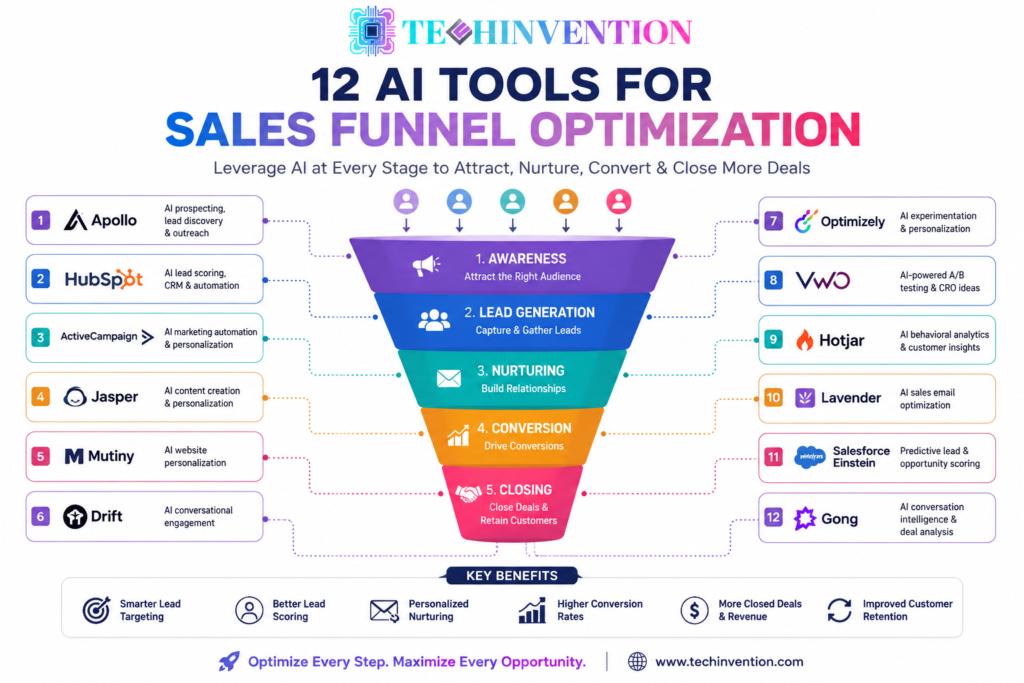
If you want more leads, better-qualified prospects, and a healthier pipeline, you do not need more random software.
You need the right AI tools for sales funnel optimization.
I’ve researched this space carefully, and one thing is crystal clear: AI is no longer just writing emails or producing ad copy. It is helping businesses score leads, analyze buyer intent, personalize journeys, improve landing pages, automate follow-ups, and uncover what actually moves revenue.
And that matters because a funnel usually does not fail all at once.
It leaks in small places.
A weak landing page here.
Slow follow-up there.
Poor lead prioritization somewhere else.
Generic messaging almost everywhere.
That is exactly where AI can help you.
In this guide, I’ll walk you through 12 of the best AI sales funnel tools, explain where each one fits, show you how to use them step by step, and help you decide which one is worth buying for your business.
Also, if you’re still learning the basics of funnel building, this resource on 20 Mistakes Do Beginners Usually Make When Creating a Funnel? is worth reviewing first because it gives useful context around the structural mistakes that often sabotage conversions before AI tools ever enter the picture.
What Is AI Sales Funnel Optimization?
AI sales funnel optimization is the process of using artificial intelligence to improve every stage of your funnel, from awareness to conversion to retention.
In plain English, it means using machines to spot patterns that humans miss, automate work that humans repeat, and improve decisions that directly affect revenue. That can include AI lead scoring, predictive sales analytics, website personalization, A/B testing with AI, customer journey analytics, and sales engagement automation.
In other words, instead of guessing which lead matters, which page needs fixing, or which message converts, you let data and AI narrow the field so you can act faster and smarter.
Why AI Is Changing Sales Funnels in 2026
The big shift in 2026 is not that businesses use more AI.
It is that AI is becoming embedded across the entire revenue workflow.
Modern platforms now connect data, prediction, personalization, automation, and measurement in one loop. A visitor arrives, behavior gets tracked, high-intent signals are detected, the lead gets scored, messaging gets adapted, outreach gets triggered, and the rep gets guided toward the best next action.
Even academic research now shows AI-driven lead ranking can improve top-lead precision and generate measurable lift in production environments, not just in theory. That is why buying the right tool is no longer a “nice to have.” For many teams, it is becoming a competitive advantage.
How to Use AI Across a Funnel Step by Step
Step 1: Attract the right traffic
Start by improving the top of funnel.
Use AI for content personalization, ad messaging, prospect targeting, and behavioral segmentation. The goal here is not just volume. It is attracting people who are actually likely to buy. This is where tools like Apollo, Jasper, and Drift shine because they help teams personalize outreach, create relevant messaging, and engage visitors in real time. If your top of funnel is attracting the wrong audience, everything downstream gets more expensive and harder to fix.
Step 2: Qualify leads faster
Next, focus on AI lead qualification and predictive lead scoring.
This is one of the highest-ROI use cases in the whole category because reps waste huge amounts of time chasing weak leads. Tools like HubSpot and Salesforce Einstein analyze historical conversion patterns, engagement behavior, and fit signals to help your team prioritize who deserves attention first. If you want a faster pipeline without adding more headcount, this is usually the first place to invest.
Step 3: Nurture leads with smarter automation
Not every lead buys right away.
That is why AI marketing automation matters.
Tools like ActiveCampaign can personalize timing, content, segments, and channels so your follow-up feels relevant instead of robotic. This is where many funnels quietly win or lose. Good nurturing builds trust. Bad nurturing creates noise. When AI can identify who should receive what message and when, your funnel becomes more efficient without becoming more aggressive.
Step 4: Optimize conversion points
After that, turn your attention to landing pages, forms, CTAs, pricing pages, and demos.
This is where conversion rate optimization, AI-powered A/B testing, and user behavior analysis become powerful. Platforms like Optimizely, VWO, and Hotjar help you understand friction, generate test ideas, and identify what is blocking conversions. If your funnel gets traffic but underperforms on conversion, this stage deserves immediate attention.
Step 5: Improve sales conversations and follow-ups
Finally, optimize the middle and bottom of funnel.
This is where Gong, Lavender, and conversational tools like Drift can have outsized impact. They help sales teams analyze calls, uncover objections, personalize follow-up, and route leads more intelligently. By the time a buyer is talking to you, small improvements in relevance, timing, and clarity can create meaningful revenue gains.
12 Best AI Tools for Sales Funnel Optimization
1. HubSpot – Best for AI Lead Scoring and Funnel Visibility
If you want one platform that touches a large part of the funnel, HubSpot is one of the strongest options.
Its AI-assisted engagement scoring helps teams identify promising leads by analyzing past conversions and combining fit and engagement signals from the buyer journey. That makes it especially useful for businesses that want an all-in-one system for CRM, lead management, nurturing, and funnel tracking. I like HubSpot because it is practical. It gives sales and marketing a shared view of which leads matter and why. If your team struggles with prioritization, slow follow-up, or poor sales-marketing alignment, buying HubSpot can solve several bottlenecks at once.
Best for:
- AI lead scoring
- sales funnel analytics
- CRM-based prioritization
- nurture workflows
2. Salesforce Einstein – Best for Predictive Lead Scoring
If your sales process is more complex or enterprise-heavy, Salesforce Einstein is a serious contender.
Einstein uses machine learning to identify patterns in converted leads and assign scores based on similarity to those outcomes. It also highlights the fields that influence the score most, which is useful because it gives your team more than a number. It gives them reasoning. That is a big deal when leadership asks why one lead should be prioritized over another. If your business already runs on Salesforce and you want deeper predictive sales analytics and sales pipeline optimization, this tool is easy to justify.
Best for:
- predictive lead scoring
- sales pipeline optimization
- enterprise sales teams
- opportunity prioritization
3. Gong – Best for Revenue Intelligence and Call Analysis
Most funnels focus too much on forms and not enough on conversations.
That is a mistake.
Gong captures and analyzes calls, meetings, and emails to identify buying signals, objections, pipeline risk, and next steps. That means you are no longer relying on rep memory or incomplete CRM notes. You are learning from real buyer interactions. I see Gong as a must-have for teams with long consideration cycles because it helps you understand what buyers actually care about. If you want better coaching, stronger discovery, and more consistent deal execution, this is the kind of product that can justify its price quickly.
Best for:
- revenue intelligence
- deal intelligence
- objection handling
- sales coaching
4. ActiveCampaign – Best for AI Marketing Automation
If your funnel weakness is in nurturing, ActiveCampaign deserves a close look.
Its platform emphasizes AI-driven personalization across content, timing, channels, and audience segmentation. In practice, that means you can automate smarter journeys instead of just sending scheduled email sequences. I especially like it for SMBs, eCommerce brands, agencies, and SaaS teams that need better lead nurturing, behavioral personalization, and cross-channel follow-up. If your business depends on warming up leads over time, this tool can make your funnel feel much more human while still scaling.
Best for:
- AI marketing automation
- lead nurturing
- behavioral segmentation
- email and SMS journeys
5. Apollo – Best for AI Prospecting Tools
At the top of funnel, Apollo is one of the strongest names in the market.
Its AI helps with prospect discovery, account research, prioritization, outreach, and list building using real data and buying signals. That makes it highly useful for teams that need to generate pipeline, not just manage it. If your reps spend hours researching accounts, building lead lists, and personalizing cold outreach manually, Apollo can cut that time dramatically. For outbound-heavy businesses, that alone can make it worth buying.
Best for:
- AI lead generation
- sales prospecting AI
- outreach personalization
- list building
6. Optimizely – Best for AI-Powered A/B Testing
You do not optimize a funnel by changing random button colors.
You optimize a funnel by testing what matters.
That is where Optimizely comes in. Its experimentation platform uses AI across ideation, testing, and next-step recommendations. This makes it useful for teams that want a disciplined approach to landing page optimization, conversion funnel optimization, and personalization. If your business already has traffic and a reasonable offer, Optimizely can help you unlock more value from what you already have instead of forcing you to buy more clicks.
Best for:
- A/B testing with AI
- conversion rate optimization
- experiment planning
- website testing
7. VWO – Best for Conversion Optimization Tools
VWO is especially strong when you need help turning insight into experiments.
Its Ideas feature can generate AI-based testing suggestions based on page content or goals, helping teams move from “we should improve this page” to a specific hypothesis much faster. That makes it appealing for marketers who know conversion optimization matters but do not always know what to test next. If your pages are underperforming and your team needs faster experimentation, this is a smart buy.
Best for:
- AI conversion rate optimization
- conversion optimization tools
- test ideation
- hypothesis building
8. Hotjar – Best for Customer Behavior Analysis
Sometimes the smartest funnel improvement is not more automation.
It is more understanding.
Hotjar, now within the broader Contentsquare experience, helps teams analyze heatmaps, session replays, funnels, surveys, and AI-powered summaries to identify friction and drop-off points. If your conversion rate is weak and you are not sure why, this type of behavioral evidence is invaluable. Before you change copy, redesign pages, or launch more traffic campaigns, it helps to know what visitors are actually doing.
Best for:
- customer behavior analysis
- funnel performance analysis
- heatmaps
- friction detection
9. Mutiny – Best for Website Personalization
Personalization is one of those ideas everyone talks about, and few teams execute well.
Mutiny helps close that gap.
Its positioning focuses on helping customer-facing teams create personalized assets, landing pages, ABM experiences, and follow-ups without heavy technical setup. If you are selling into different industries, account sizes, or buyer segments, showing everyone the same message is lazy marketing. Mutiny gives you a better alternative. For B2B brands especially, that can translate into more qualified meetings and stronger mid-funnel momentum.
Best for:
- website personalization
- 1:1 ABM
- landing page customization
- account-based experiences
10. Lavender – Best for Sales Email Optimization
Cold outreach still matters.
It just needs to stop sounding cold.
Lavender helps reps write better emails by scoring drafts, surfacing personalization data, and recommending improvements designed to increase replies. If your funnel depends on outbound, better email quality can drive better meeting rates with almost no change to your offer. I like this tool because it is narrow, useful, and easy to understand. It improves one important lever without pretending to be your whole stack.
Best for:
- sales email optimization
- personalized sales emails
- reply-rate improvement
- faster outreach
11. Jasper – Best for Funnel Messaging and Content Personalization
Jasper fits best as a messaging layer across the funnel.
It helps teams create on-brand content for landing pages, email campaigns, product messaging, ads, and nurture assets. That matters because content supports nearly every stage of the funnel, from awareness to consideration. The key thing, though, is this: content generation alone is not funnel optimization. The content still needs testing, measurement, and audience relevance. Used properly, Jasper helps you scale messaging faster while keeping it aligned and usable.
Best for:
- AI marketing content
- campaign messaging
- nurture content
- landing page copy
12. Drift – Best for Conversational AI for Sales
When buyers have questions, delay kills momentum.
That is why conversational tools still matter.
Drift, now positioned within the SalesLoft ecosystem, focuses on AI chat agents that engage site visitors in real time, personalize conversations, capture buyer intent, and trigger seller actions. If your website gets meaningful traffic but too many visitors leave without taking action, this category can help you recover demand that would otherwise disappear. For many B2B teams, that can be a direct pipeline win.
Best for:
- conversational AI for sales
- visitor qualification
- real-time engagement
- meeting routing
How to Choose the Right Tool
Buying the wrong AI tool is easy.
Buying the right one takes discipline.
Start by identifying your biggest funnel bottleneck. If you struggle with lead prioritization, buy HubSpot or Salesforce Einstein. If you struggle with nurturing, buy ActiveCampaign. If your landing pages underperform, look at Optimizely, VWO, or Hotjar. If outreach quality is poor, lean toward Apollo or Lavender. And if your team needs better buyer engagement on-site, Drift or Mutiny may be the smarter choice. Do not buy based on hype. Buy based on the stage of the funnel that is leaking the most revenue.
Frequently Asked Questions
1. What are the best AI tools for sales funnel optimization in 2026?
The best AI tools for sales funnel optimization help businesses automate lead generation, personalize customer journeys, analyze funnel performance, create content, qualify prospects, and improve conversion rates. Popular categories include AI-powered CRM platforms, chatbots, email automation tools, analytics platforms, landing-page optimization tools, and AI copywriting solutions.
2. How can AI tools increase sales funnel conversions?
AI tools can increase conversions by analyzing customer behavior and identifying where prospects drop out of the funnel. They can then personalize content, recommend relevant offers, automate follow-ups, qualify leads, and optimize landing pages based on performance data. This allows businesses to deliver the right message to the right customer at the right stage.
3. Which AI tools are best for lead generation?
AI lead-generation tools can identify potential customers, analyze visitor behavior, automate prospecting, and qualify leads before they reach your sales team. The right tool depends on whether you need website lead capture, outbound prospecting, CRM-based lead scoring, or conversational AI.
4. Can AI automate the entire sales funnel?
AI can automate many parts of a sales funnel, but it should not necessarily replace human involvement completely. AI can handle tasks such as lead qualification, email follow-ups, customer segmentation, content personalization, chatbot conversations, and performance analysis, while sales teams can focus on high-value conversations and closing deals.
5. How does AI improve lead qualification in a sales funnel?
AI improves lead qualification by analyzing information such as customer behavior, demographics, engagement, website activity, and previous interactions. It can assign lead scores and identify prospects that are more likely to convert, helping sales teams prioritize their time and resources.
6. What role does AI play in sales funnel personalization?
AI uses customer and behavioral data to personalize emails, landing pages, product recommendations, advertisements, offers, and follow-up messages. Instead of showing every visitor the same experience, AI can help businesses create more relevant experiences based on each prospect’s interests and position in the funnel.
7. Can AI tools optimize landing pages for higher conversions?
Yes. AI-powered landing-page tools can help generate headlines, copy, layouts, calls to action, and variations for testing. Some platforms can also analyze visitor behavior and conversion data to identify opportunities for improving landing-page performance.
8. How can AI improve email marketing conversions?
AI can improve email marketing by helping businesses personalize messages, segment audiences, generate subject lines, determine optimal sending times, automate follow-ups, and analyze engagement. AI-powered email automation can also trigger different messages depending on how a prospect interacts with previous emails.
9. What is AI-powered lead scoring?
AI-powered lead scoring is a system that uses data and machine-learning models to evaluate how likely a prospect is to become a customer. Instead of relying only on fixed rules, AI can analyze multiple behavioral and customer signals to identify high-intent leads and help sales teams prioritize them.
10. How do I choose the right AI tool for my sales funnel?
Choose an AI tool based on your funnel’s biggest weakness. Start by identifying whether you need better lead generation, qualification, personalization, email automation, landing-page optimization, analytics, or customer support. Then compare integrations, pricing, ease of use, automation capabilities, data security, scalability, and measurable conversion benefits.
11. Are AI sales funnel tools suitable for small businesses?
Yes. Small businesses can use AI sales funnel tools to automate repetitive marketing and sales tasks without building a large team. Affordable AI solutions can help with lead capture, customer communication, content creation, email automation, appointment scheduling, and analytics, allowing small teams to focus on growth.
12. How can Tech Invention help businesses optimize their sales funnels with AI?
Tech Invention can help businesses identify funnel bottlenecks and implement AI-powered strategies for lead generation, customer segmentation, automation, personalization, analytics, and conversion optimization. By combining AI with data-driven digital marketing, businesses can create more efficient sales funnels designed to attract qualified prospects and turn more leads into customers.
Final Thoughts: Don’t Just Automate Your Funnel—Optimize It
AI is changing the way businesses approach sales funnels.
But here’s the key:
AI isn’t the strategy. AI supports the strategy.
The winning approach is to identify your biggest funnel problem first, choose the technology that solves that problem, connect it to useful data, define a measurable KPI, and continuously test the outcome.
Maybe you need better AI lead generation.
Maybe your sales team needs predictive lead scoring.
Maybe your landing page needs conversion rate optimization.
Or perhaps your biggest opportunity is simply following up with interested prospects faster.
Whatever the bottleneck, there is an AI solution worth testing.
And if you don’t have the expertise or resources to build that system yourself, this is where Tech Invention can help.
Ready to Build a Smarter AI-Powered Sales Funnel?
At Tech Invention, we help businesses turn AI from an interesting technology into a practical growth system.
From AI automation and lead generation to customer journey optimization, data-driven marketing, conversion strategy, and intelligent sales workflows, the goal is straightforward:
Build a funnel that works smarter—not simply harder.
If you’re ready to identify your funnel bottlenecks, choose the right AI technology, and create a strategy designed around measurable business outcomes, contact Tech Invention today and start building your AI-powered growth engine.