

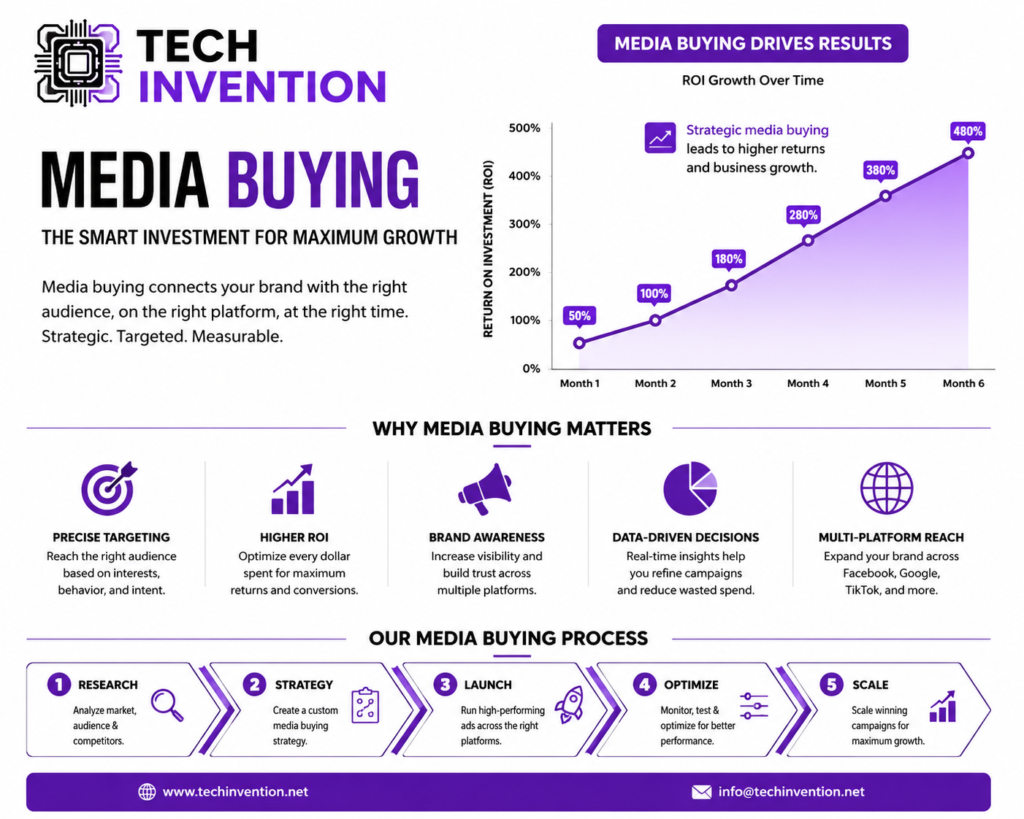
Media buying is a practice that purchases ads across traditional and digital media channels to reach target audiences effectively and maximize campaign performance and return on Ad Spend (ROAS). When done effectively, media buying can help businesses reduce wasted ad spend, reach high-intent audiences, and drive measurable growth.
Finding your product or service in front of the right people at the right moment at an acceptable cost can be a difficult challenge. Advertising options have expanded over the past decade:
Google AdWords, Meta, TikTok, programmatic platforms, connected TV channels, podcasts, out-of-home displays: the choices are many, and costly mistakes could cost real money.
It has quickly become one of the most crucial skills in modern marketing, thanks to its proven ability to transform a modern advertising budget into an efficient revenue stream; conversely, poorly executed strategies may drain it and leave nothing but wasted spending behind.
This comprehensive media buying guide for 2026 covers everything you need to know about media buying: from what it is and how it works to strategy,
platform selection, performance measurement, budgeting, and budgetary considerations; budgetary considerations are covered too, as are common mistakes within this field, as well as current industry trends that could impact you either directly or by working with an agency.
If you’re managing campaigns internally or considering hiring an outside media buying agency, this should serve as your starting point.
What Is Media Buying?
Media buying refers to the practice of purchasing advertising spots across digital and traditional media channels in order to reach a specific target audience while optimizing campaign performance and return on ad spend (ROAS).
At its core, media buying answers two questions: where and how should ads appear, and at what cost should those placements appear. The goal should be putting your message out there at an acceptable cost to reach its intended audience.
It follows a simple process. First, media buyers identify which channels and placements will likely reach their target audience;
then they fix pricing and secure inventory via direct deals with publishers or automated platforms; finally, ads go live, performance is monitored closely, and campaigns can be optimized based on results
Digital media buying has revolutionized media purchasing, making the process faster and more data-driven than ever. Advertisers can now bid on ad placements within milliseconds, adjust spending in real time, and accurately calculate cost per conversion rates.
What Does a Media Buyer Do?
A media buyer is accountable for selecting ad placements, negotiating rates, managing budgets, and optimizing campaign performance. Their daily tasks may involve researching audience behavior and selecting platforms with which they’d like to run campaigns;
monitoring key metrics like CTR and ROAS while making data-driven adjustments in order to improve results.
Media buyers collaborate closely with creative teams (to ensure ads resonate with their placement), analytics teams (for tracking conversions), and finance teams (to keep within budget).
Media Buying vs. Media Planning:
Both functions are closely intertwined but distinct; media planning determines your strategy – who to target, which channels to use, and what objectives your campaign aims to meet- whereas media buying is used for actual placement purchase according to what the media plan identified as desirable placements.
Why Is Media Buying Important for Businesses?
Businesses that need to expand can often resort to paid media buying as an effective and repeatable strategy to expand. Organic reach alone rarely satisfies business expansion goals, while media buying provides businesses with a proven and measurable way of expanding.
Reaching Your Target Audience:
Audience targeting is at the core of successful media buying. Modern platforms allow advertisers to define audiences based on demographics, interests, behaviors, locations, device type, and purchase intent.
but programmatic advertising takes this even further by using machine learning algorithms to bid on impressions with high conversion potential and bid accordingly.
Maximize Advertising Budget strategy.
Systematic media buying helps maximize advertising budget. By choosing placements where your audience actually spends their time and constantly optimizing campaigns based on performance charts, strategic media buying maximizes every dollar spent for maximum value.
Increase Brand Recognition
Regular exposure to targeted advertisements builds brand recognition. Display advertising and video ads play an important role in keeping your brand at the forefront of customers’ minds throughout their purchase journeys.
Improve Marketing ROI
Target Media Buy to Generate Leads and Sales: Performance-focused media buying by Google Ads or Meta Ads can create direct leads and sales with measurable cost per acquisition (CPA), making paid advertising one of the most accountable channels available to marketers.
Media buying that includes ROAS measurement and conversion tracking is among the most cost-effective strategies to allocate marketing budgets.
With the ability to pause unproductive placements and expand what does well, advertisers get more control than traditional channels on their own.
What Are the Main Types of Media Buying?
Digital Media Buying:
This form of media buying encompasses any paid ad placement online–search, social, display, video, and programmatic ads–that pays. It has become the dominant form today due to its precise targeting capabilities, real-time optimization features, and ability to measure results accurately.
Programmatic Media Buying
Automated media buying (PMB) refers to the practice of purchasing digital ad inventory using algorithms and real-time bidding (RTB). Advertisers utilize demand-side platforms (DSPs) for bidding impressions across millions of websites and apps simultaneously.
Programmatic advertising now accounts for most global digital display ad spending.
Social Media Advertising
Social Media Advertising refers to paid placements on platforms like Meta (Facebook and Instagram), TikTok, LinkedIn, Pinterest, and X (formerly Twitter).
These platforms offer some of the most sophisticated audience targeting tools available – making social media ads especially effective in both brand awareness campaigns as well as direct response initiatives
.
Search and Pay-per-Click (PPC) Advertising
Pay-per-click (PPC) ads run primarily through Google Ads are designed to reach users actively searching for products or services relevant to them, and often result in high conversion rates with clear returns on ad spend.
Display Advertising
Display ads (banners, rich media ads, and native ads) can be placed across websites and apps to reach audiences who have previously visited your website and build brand recognition at scale.
Retargeting can also be achieved using display campaigns; reaching visitors who have already visited is another benefit.
Video and YouTube Advertising
Advertising on YouTube and connected TV platforms provides high engagement while offering broad reach. YouTube Ads feature various formats ranging from skippable in-stream ads to non-skippable bumper ads that enable advertisers to tailor delivery according to campaign goals.
Traditional Media Buying
Traditional media buying includes TV, radio, print media, outdoor (billboards and transit ads), direct mail advertising, as well as direct mailing campaigns.
Although digital strategies dominate most paid media strategies, these traditional channels remain viable ways of reaching mass audiences or regional markets.
How to Develop an Effective Media Buying Strategy
1. Define Your Marketing Goals
Before spending a single dollar on marketing efforts, clearly outline your desired outcomes. Brand awareness campaigns differ significantly from lead generation efforts–while lead gen is measured differently still from direct e-commerce sales.
Clear goals determine everything else: channel selection, ad formats, bidding strategies, and success metrics.
2. Your Target Audience Selection
Create detailed audience profiles using demographic, behavioral, and first-party customer data to define your target audience accurately. Doing this will save money spent advertising to audiences that won’t convert.
3. Advertising Budget Maximization
Your budget should reflect your goals rather than random allocation. Work backwards from your CPA/ROAS target to establish how much investment is necessary to meet them. Remember to factor in testing costs too – new campaigns typically need time before optimal results
.
4. Select the Appropriate Media Channels
Identifying appropriate media channels depends upon understanding who your audience is rather than following trends. When marketing to B2B decision-makers, LinkedIn Ads outperform TikTok;
while for consumer products targeting broad audiences, Meta Ads or Google Ads may provide stronger starting points.
5. Select Active Ad Formats
Each objective calls for different ad formats: video ads can create awareness and emotional engagement while text-based search ads capture purchase intent.
Carousel ads on social media showcase product ranges; make sure your ads align with whatever stage of the funnel they’re targeting.
6. Strategize Your Ad Placements
In both programmatic and display campaigns, placement matters greatly. Ads on high-quality sites with relevant ad types perform better while carrying brand safety with low risk.
On social media ads (feed vs stories vs reels), placement can affect both cost and engagement rates.
7. Launch and Monitor Campaigns
As soon as your campaigns go live, make sure to monitor them daily in their initial phase. Look out for anomalies–high CPCs, low CTRs, or tracking failures–that require immediate attention so as to shape your optimization strategy as early data drives optimization strategies.
8. Enhance Campaign Performance
Ongoing optimization separates good media buying from great media buying. Testing creatives, refining audience targeting, and reallocating budget to the highest-performing placements are all integral parts of an effective media buying campaign – never leave one running on autopilot for too long!
9. Measure ROI and ROAS
Measure every campaign against revenue impact with return on ad spend (ROAS), a metric which shows you the amount of revenue generated for every dollar spent advertising. Combined with customer lifetime value (LTV), ROAS helps you understand the long-term profitability of each acquisition.
How Does Digital Media Buying Work?
Digital media purchasing involves numerous interdependent players. Understanding these relationships will enable you to make better platform and budget decisions.
Advertising Firm (Your Company):
An advertiser (you or your business) determines campaign goals, target audiences, and budget. Either they manage these processes directly themselves or work with media buying agencies.
Demand-Side Platform (DSP)
A demand-side platform (DSP) is software that enables advertisers to purchase digital ad inventory programmatically across multiple ad exchanges.
DSPs use data and algorithms to identify and bid for relevant impressions in real time, such as The Trade Desk, Google Display & Video 360, and Amazon DSP – among others.
Ad Exchange
Ad exchanges are digital marketplaces where publishers sell their ad inventory to advertisers, and the exchange facilitates this transaction – usually within milliseconds – by connecting supply with demand through automated bidding systems.
Supply-side Platform (SSP)
Supply-side platforms (SSPs) enable publishers to efficiently and profitably sell, manage, and optimize their advertising inventory. SSPs connect publishers to multiple ad exchanges and DSPs simultaneously in order to maximize revenue generated per impression.
Real-Time Bidding (RTB)
Real-time bidding (RTB) is the foundation of programmatic advertising. Every time someone loads a page, a microsecond-by-millisecond auction takes place between advertisers, based on criteria
Such as audience match, bid price, and ad quality; with RTB offering highly targeted media buying at massive scale at very cost-efficient rates.
Which Platforms Should Be Used for Media Buying? Below Is A Comparison Table
Each Platform Has Its Own Strengths For Targeting Strengths, CPM ranges, and Comparison Tables; each is best used.
For Target Strengths, Target Device Remarketing Retargeting Remarketing, Location Device, Retargeting Varies By Keyword and Varies by Location or device; retargeting Remarketing Varies By Keyword.
The Following are Examples of Ad Formats Used for media buying: Keyword, location device remarketing, retargeting on audiences, demographics, interests, behaviors, lookalikes within 5-15$ range per campaign, whilst YouTube Ads.
YOUTUBE ADS
Video brand awareness and product consideration around demographics, interests, topics, and keywords for $2-$10 per campaign. LinkedIn Ads Went Beyond Lead Generation and Professional Audience targeting: job title, company size, industry, seniority = $25-50, and TikTok Ads are suitable for use.
Gen Z and millennial brand awareness, viral content creation and promotion; interests, behaviors and demographic targeting will cost anywhere between $8-20 USD on programmatic platforms (scaled display ads, retargeting TV commercials, etc.).
Contextual behavioral data as well as first-party data is collected as first-party data (between $1-10).
Google Ads
Google Ads remains the premier platform for search-based advertising, processing over 8.5 billion searches each day (according to Internet Live Stats). Google Ads also powers display advertising through the Google Display Network and YouTube Ads for video ad products.
Meta Ads (Facebook and Instagram)
Meta Ads (Facebook and Instagram) provide some of the most granular audience targeting available in digital advertising. Boasting over 3 billion monthly active users across its family of apps (Meta 2024),
these ads can be particularly effective for consumer brands, e-commerce businesses, lead generation campaigns, and lead gen campaigns.
Google estimates that YouTube reaches over 2.5 billion active monthly users (Google, 2024). YouTube Ads are highly effective for product demos, brand storytelling, and engaging viewers at the consideration stage of a purchasing journey.
LinkedIn Ads
are the premier media solution for B2B media buying. Their targeting capabilities of job title, company, industry, and seniority level make LinkedIn Ads especially well suited to reaching business decision-makers; though with higher CPMs, budget optimization is required.
TikTok Ads:
TikTok’s advertising platform has rapidly evolved. Boasting an excellent reach among those under 35, TikTok Ads provide consumer brands with an opportunity to invest in native-feeling short-form video creative that resonates with target users on TikTok – with an algorithm-driven discovery mechanism providing cost-efficient reach when ads resonate with audiences.
Programmatic Advertising Platforms
Programmatic ad platforms like The Trade Desk, Google DV360, and Amazon DSP enable advertisers to purchase inventory across thousands of websites, apps, and connected TV platforms simultaneously – perfect for scaled display ads, retargeting, or audience expansion campaigns.
Demand-Side Platforms
DSPs are at the core of programmatic media buying. Selecting the ideal DSP depends on your industry, data needs, and inventory type preferences – enterprise advertisers often utilize multiple DSPs simultaneously to maximize reach and inventory quality.
How Can Media Buying Performance Be Assessed?
Click-Through Rate (CTR):
CTR measures the percentage of users who click your ad after seeing it and, typically, a higher CTR indicates successful creative and targeting; however, CTR alone won’t show whether clicks translate to revenue.
Cost per Click (CPC):
CPC measures the average amount you pay each time someone clicks your ad, with lower CPC being beneficial if it attracts your target audience; cheaper clicks from non-relevant users constitute wasted spend.
CPA stands for Cost Per Acquisition and measures how much it costs to acquire one customer or lead. CPA is one of the key metrics of performance-based media buying as it links advertising spend directly with business outcomes.
Conversion Rate
Conversion rate refers to the percentage of clicks or impressions that lead to desired actions such as purchases, sign-ups, or form submissions. Improving conversion rate often yields better return on advertising spend (ROAS) than simply decreasing CPC costs.
Return on Ad Spend (ROAS)
ROAS stands for Return on Ad Spend, or Revenue Generated/Ad Spend. A ROAS of 4x indicates you generated $4 in revenue for every $1 spent on advertising; target ROIs can differ based on industry and margin, but most e-commerce businesses aim for at least 3-5x return.
Impressions and Reach
Impressions measure how often your ad was seen, while Reach indicates how many users actually saw it – both metrics can help position brand awareness campaigns where exposure rather than immediate conversion is the desired goal.
Customer Acquisition Cost (CAC)
CAC goes beyond CPA by taking into account all marketing and sales costs depending on customer behaviour – not only advertising spend – to assess its long-term sustainability.
Tracking CAC can help establish whether the media buying strategy will remain sustainable over time.
How Should You Spend on Media Purchasing?
Factors That Affect Your Advertising Budget
Many factors affect media buying costs: your industry (competition drives up CPCs in legal, finance, and insurance sectors), target audience size, geographic targeting, campaign objectives and platforms you use; as well as seasonality–ad costs usually spike during Q4.
Budget for Small Business Media Buying:
A reasonable starting budget range for media purchases for a small business should range between $1,000-$5,000 monthly across one or two platforms, depending on its purpose and size of company. Prioritise one channel at first to test and learn before expanding once profitable groundwork has been set in place.
Budget for B2B Media Buying
Since B2B ads (such as LinkedIn Ads ) tend to carry higher CPMs, budgets should reflect that reality. Most B2B companies running LinkedIn campaigns allocate between $3,000-$5,000 monthly in order to achieve meaningful data and results from these efforts.
E-Commerce Advertising Budget:
Businesses typically allocate 10-20% of revenue to paid advertising, adjusting spend based on Return on Ad Spend (ROAS). Google Shopping ads and Meta Ads Retargeting campaigns are two popular options that should be prioritized when setting an e-commerce advertising budget.
How to calculate Ad Spend
A practical allocation framework for most businesses includes allocating 60-70% of budget towards proven channels with high return-on-ad-spend (ROAS); 20-30% to testing out new platforms, audiences, or formats; and keeping 10% in reserve for opportunistic scaling of campaigns that outshone expectations.
Avoid Common Media Buying Mistakes
Selecting an Appropriate Advertising Platform:
Not every platform works for every business. Advertising on TikTok simply because it’s trending could align your budget with your audience; platform selection must affect audience behavior rather than industry fads.
Targeting the Wrong Audience
Broad targeting is wasteful of budget. Narrow targeting reduces reach while increasing CPC costs; precision is key when reaching buyers without missing valuable segments.
Spending Without Clear Goals:
Campaigns without clear objectives are virtually impossible to maximize, so before beginning any such endeavors, it is vital that specific, measurable goals tied directly to business results instead of vanity metrics are established in advance.
Failing to Track Conversions
Without proper conversion tracking tools in place, it can be impossible to determine what works accurately. Implementing Google Tag Manager, Meta Pixel, and platform-specific conversion events is important before spending money.
Ad Creatives That Don’t Perform
Ad confusion is real. Repeated use of one creative over time leads to many returns. Regular A/B AD testing with headlines, images, copy, and CTAs keeps campaigns regular while providing insights into what performs best with audiences.
Media buying should never be done passively: campaigns require regular review, bid adjustments, audience refinements, and creative refreshes to maintain performance over time.
Focusing On Clicks Instead of Revenue
High-traffic campaigns that fail to convert into revenue are more of a liability than an asset. Always trace performance back to actual leads, sales, or customer clicks and cost results rather than simply tracking clicks and impressions.
Media Buying Trends to Watch in 2026
AI-Powered Media Buying
AI is revolutionizing media buying at every level–from audience targeting and bid optimization, creative testing, and budget allocation. Companies such as Google and Meta are already using machine learning to optimize delivery automatically; by 2026, advertisers
who understand how to guide AI systems with quality data and clear goals will outshine those solely relying on manual management alone.
Traditional Advertising
Traditional advertising continues its rapid expansion beyond display ads into connected TV (CTV), DOOH ads, and audio formats. Programmatic’s share of total digital ad spend is projected to keep increasing as more inventory becomes available via automated channels.
First-Party Data
Now that third-party cookies have largely been eliminated from media buying strategies, first-party data like customer lists, CRM information, and website behavioral data has become the cornerstone of media buying. Advertisers that invest in robust first-party data strategies will enjoy significant targeting advantages over their counterparts.
Connected TV (CTV) advertising enables brands to connect with streaming audiences on smart TVs with the precision and targeting of digital media buying. As streaming viewership continues to expand and linear TV audiences continue to decline, CTV advertising is fast becoming a core element of paid media strategies.
Performance Max (Google) and Advantage+ (Meta) represent an evolving shift towards fully automated campaign management, using AI technology to optimize placements, audiences, and formats consistently.
Becoming adept at working with rather than against these systems has become a crucial media buying skill.
Privacy-Focused Advertising
Regulatory pressure and platform policy changes are altering how advertisers collect and utilize data, with contextual targeting (placing ads based on content rather than user data) becoming an attractive alternative to behavioral targeting as an approach that protects privacy.
Cross-Channel Media Buying:
Attribution modeling across multiple channels is becoming more complicated. Leading advertisers have gone beyond last-click attribution and established holistic measurement frameworks that demonstrate how channels fit together throughout the customer journey.
AI-Generated Ad Creative
AI creative tools are rapidly increasing their capacity to produce ad variants faster for testing, personalization at scale, and dynamic creative optimization (DCO).
Brands who employ these AI creative tools strategically while pairing them with strong human creative direction have found that using these automated creatives reduces production costs while increasing test velocity.
Tech Invention, a digital advertising agency, has recently helped an online retailer rethink their strategy for buying media after months of decreasing ROAS.
Their team analyzed current campaigns and discovered the cost of budgets wasted due to excessive targeting or outdated creativity and then redesigned their client account around precisely defined audiences using an automated testing framework for creativity.
Media Buying Strategies That Produce Results
Successful media buying requires precision, patience, and an openness to testing, learning, and adapting. While the fundamentals haven’t changed–
reaching the right audience with relevant messages at an acceptable cost–tools and platforms made available today allow media buyers to achieve this level of efficiency that was simply unachievable several years ago.
FAQ Section
What Is Media Buying?
Media buying is the process of purchasing advertising placements across digital or traditional channels to reach a defined audience and achieve specific marketing objectives.
What Is a Media Buying Strategy?
A media buying strategy defines the target audience, advertising channels, budget, placements, timing, creative formats, and performance metrics used to achieve campaign goals.
What Is the Difference Between Media Buying and Media Planning?
Media planning determines where, when, and how advertising should run, while media buying executes the plan by purchasing and managing advertising placements.
What Is Programmatic Media Buying?
Programmatic media buying uses automated technology to purchase digital advertising inventory and optimize placements according to audience and campaign requirements.
What is the difference between media buying and media planning?
Media planning establishes the campaign strategy, channels, audience, timing, and budget, while media buying executes that plan by securing advertising placements.
How does media buying work?
Media buying involves defining campaign goals, researching audiences, selecting channels, allocating budget, purchasing placements, launching campaigns, tracking performance, and optimizing results.
What is digital media buying?
Digital media buying involves purchasing advertising placements on websites, search engines, social media platforms, apps, video platforms, and programmatic networks.
What is programmatic media buying?
Programmatic media buying automates the purchase and placement of digital advertisements using technology, audience data, and automated bidding.
How much does media buying cost?
The cost depends on the advertising platform, target audience, campaign objectives, industry, competition, geographic market, and advertising budget.
Is media buying suitable for small businesses?
Yes. Small businesses can use targeted media buying to reach specific audiences and control advertising budgets while measuring leads, conversions, and return on ad spend.
Which platforms are best for media buying?
Google Ads, Meta Ads, YouTube, LinkedIn, TikTok, and programmatic platforms can all be effective. The best platform depends on the target audience and campaign objective.
What KPIs should I track for media buying?
Important KPIs include CTR, CPC, CPA, conversion rate, impressions, reach, CAC, and ROAS Should businesses hire a media buying agency?
Businesses can benefit from an experienced media buying agency when they need professional campaign strategy, audience targeting, budget management, creative testing, optimization, and performance reporting.
Grow Your Business With Professional Media Buying Services
Ready to get more from your advertising budget?
Tech Invention provides strategic digital marketing, paid advertising, SEO, web development, and campaign optimization services designed to help businesses attract qualified customers and improve online growth.