

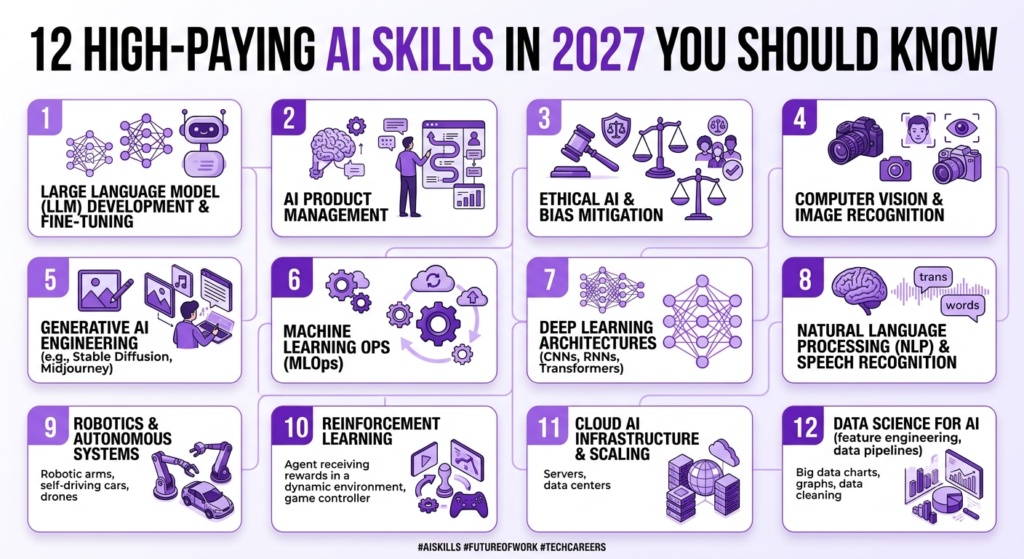
The highest-paying AI skills in 2027 will not simply involve using ChatGPT or writing clever prompts. The strongest earning opportunities are shifting toward the people who can build, connect, secure, test, and manage AI systems that actually run in production — not just demo well once.
Three things are driving this shift. First, the skills required inside AI-exposed jobs are changing unusually fast, as employers replace one-off “AI curiosity” with real technical depth. Second, companies increasingly need people who can connect AI models to real business systems — data, security, compliance, customer workflows — rather than people who can only operate a chatbot interface. Third, technical skill alone isn’t enough anymore; it has to be paired with judgment, communication, and industry context.
That last point matters because AI-exposed roles are absorbing new tasks that lean heavily on very human capabilities: judgment, empathy, and creativity. So this guide won’t claim that learning a tool guarantees a high salary. It won’t either. What follows is a practical map of the AI skills in demand in 2027, what each one actually involves, and how to start building toward one of them — without trying to learn all twelve at once[1].
Highest-Paying AI Skills in 2027 at a Glance
| AI skill | Why companies need it | Coding level | Useful tools | Career potential |
|---|---|---|---|---|
| LLM engineering | Builds and adapts language-model applications | High | Python, PyTorch, Hugging Face | Very high |
| Agentic AI engineering | Creates autonomous multi-step AI systems | Medium–high | LangGraph, CrewAI, Semantic Kernel | Very high |
| RAG engineering | Connects AI models with trusted private data | High | Pinecone, Weaviate, pgvector, LlamaIndex | Very high |
| AI security and red teaming | Protects AI systems from attacks and data leaks | High | Garak, PyRIT, security testing tools | Very high |
| MLOps and LLMOps | Deploys, monitors and maintains production models | High | Kubernetes, MLflow, cloud platforms | Very high |
| AI evaluation and testing | Measures accuracy, safety and business performance | Medium–high | Evaluation frameworks, test datasets | High |
| AI data engineering | Creates reliable data pipelines for AI systems | High | Spark, Airflow, Snowflake, Kafka | Very high |
| Computer vision | Builds systems that understand images and video | High | OpenCV, PyTorch, TensorFlow | High |
| Voice and conversational AI | Develops speech-based customer and sales agents | Medium–high | ElevenLabs, Vapi, speech APIs | High |
| AI-native software engineering | Uses coding agents while validating architecture and output | High | Copilot, Claude Code, Cursor | High |
| AI governance and compliance | Controls legal, ethical and operational AI risks | Low–medium | Governance and audit platforms | High |
| AI product management | Converts AI capabilities into valuable products | Medium | Analytics, prototyping and roadmapping tools | High |
A “Very high” rating here isn’t a promised paycheck. Real earnings depend on your location, experience level, industry, the strength of your portfolio, and — most of all — the measurable business impact you can point to.
How We Ranked These AI Skills
Rather than guessing which skills sound impressive, this list weighs four practical factors.
Employer demand. How often do job postings and hiring managers actually ask for this skill, and does the demand show up across multiple industries — not just inside software teams? AI-related hiring has been expanding well beyond engineering, touching marketing, sales, and management roles too.
Technical scarcity. Skills that are genuinely hard to learn, difficult to deploy correctly, and expensive to replace tend to command higher pay, simply because fewer people can do them well.
Business impact. Skills tied to revenue, security, cost control, reliability, regulatory compliance, or customer experience carry more weight than skills that only affect internal convenience.
Long-term durability. Some skills are durable; others are tied to a single trendy tool and fade fast. Prompt engineering, for example, is still useful — but it’s increasingly a baseline capability rather than a full specialist career on its own. Production deployment, retrieval, evaluation, and orchestration hold up better over time because they solve harder, more persistent problems.
1. LLM Engineering and Model Adaptation
LLM engineering covers working with foundation models, building API-based applications, using open-weight models, and fine-tuning through techniques like LoRA and PEFT — plus model selection and inference optimization. It pays well because businesses don’t want a generic chatbot wrapper; they want a system adapted to their own data, tone, and constraints.
Tools to learn: Python, PyTorch, Hugging Face, Transformers, LoRA, model-serving platforms, cloud GPU environments.
Portfolio project idea: Build a specialized assistant for a defined industry, evaluate its output, and document the cost, accuracy, and limitations honestly.
2. Agentic AI Engineering and Multi-Agent Orchestration
Agentic AI engineering is about building systems that can plan, call tools, remember context, hand off tasks between agents, recover from failure, and pause for human approval when needed. Companies are investing here because agents can support customer service, research, sales operations, and internal workflow automation at scale.
Tools to learn: LangGraph, CrewAI, AutoGen, Semantic Kernel, Model Context Protocol, API integrations, workflow automation platforms.
Portfolio project idea: Build an agent that researches a topic, verifies its sources, drafts a report, and requests human approval before publishing. This is a stronger project than a simple Zapier chain, because the valuable skill here is architecture and control — not just clicking integrations together.
3. RAG and Enterprise Knowledge Systems
Retrieval-augmented generation lets an AI system pull answers from documents, databases, and private knowledge sources instead of relying only on what it was trained on. It matters because it enables traceable answers, protects private company information, respects document permissions, and reduces (though doesn’t eliminate) unsupported output. Poor retrieval and outdated documents can still cause failures, so RAG isn’t a hallucination cure-all — it’s a discipline.
Tools to learn: Pinecone, Weaviate, pgvector, Elasticsearch, LlamaIndex, LangChain, embedding models, rerankers.
Portfolio project idea: Build a support assistant that answers only from an approved document set and shows its source passages.
4. AI Security and Red Teaming
This field covers defending against prompt injection, sensitive-data leakage, data poisoning, insecure tool access, model extraction, malicious file inputs, and agents with excessive permissions. It commands premium pay because it directly protects revenue, customer trust, intellectual property, and regulatory standing.
Tools and skills to learn: cybersecurity fundamentals, threat modeling, secure API design, identity and access management, adversarial testing, AI security frameworks, incident response.
Portfolio project idea: Test a fictional RAG chatbot against prompt injection attempts and write up a remediation report.
5. MLOps, LLMOps and AI Observability
This is the operational backbone: deployment, versioning, monitoring, rollbacks, cost tracking, model drift detection, prompt management, and reliability testing. A prototype that works once in a demo isn’t a business system — companies pay for stability, security, and measurable production performance over time.{2}
Tools to learn: Docker, Kubernetes, MLflow, GitHub Actions, AWS/Azure/Google Cloud, OpenTelemetry, monitoring platforms, evaluation dashboards.
Portfolio project idea: Deploy an AI application with logging, usage-cost tracking, output evaluation, and rollback capability built in.
6. AI Evaluation, Testing and Guardrails
Traditional software behaves predictably; generative AI is probabilistic. That means teams need structured ways to measure accuracy, relevance, safety, bias, latency, cost, task completion, and business impact — a discipline that’s often missing from junior AI skillsets, which makes it valuable.
Skills to develop: golden datasets, human evaluation, automated evaluation, regression testing, adversarial scenarios, acceptance criteria, business KPI measurement.
Portfolio project idea: Compare three models on the same customer-support dataset and document quality, latency, cost, and failure patterns.
7. AI-Ready Data Engineering
No model can compensate for incomplete, duplicated, outdated, or poorly governed data. This skill covers ETL/ELT, data cleaning, streaming pipelines, metadata, data lineage, access control, feature pipelines, and data quality monitoring.
Tools to learn: SQL, Python, Apache Spark, Kafka, Airflow, Snowflake, Databricks, BigQuery.
Portfolio project idea: Build a pipeline that cleans and indexes company documents for a searchable AI knowledge assistant.
8. Computer Vision and Multimodal AI
Computer vision creates value in manufacturing inspection, medical imaging, retail analytics, agriculture, robotics, document processing, and safety monitoring. The core skills are image classification, object detection, segmentation, vision transformers, video analysis, multimodal models, and data labeling/evaluation.
Portfolio project idea: Build a defect-detection system using a public manufacturing image dataset.
9. Voice AI and Conversational Systems
Voice AI specialists work on speech recognition, text-to-speech, real-time dialogue, call routing, customer-service agents, and multilingual voice systems. The hard part — and the part companies actually pay for — isn’t producing a synthetic voice. It’s managing latency, interruptions, accents, background noise, escalation paths, consent, call compliance, and CRM integration.
Portfolio project idea: Build a fictional appointment-booking assistant that transfers uncertain requests to a human operator.
10. AI-Native Software Engineering and Context Engineering
Software engineering is shifting from writing every line manually toward defining specifications, decomposing tasks, giving agents relevant context, reviewing generated code, testing output, managing security, and controlling technical debt. Context engineering — deciding what information, tools, memory, and restrictions an AI system receives — matters more here than how a prompt is worded.
Tools to learn: GitHub Copilot, Claude Code, Cursor, automated code review, testing frameworks, static analysis, secure development practices.
Portfolio project idea: Use a coding agent to build a small application, then document every error, security issue, and human correction required along the way.
11. AI Governance, Ethics and Compliance
AI governance professionals manage risk classification, model documentation, bias assessment, privacy, transparency, vendor assessment, human oversight, and audit trails. This path is well suited to people coming from legal, compliance, cybersecurity, risk management, public policy, data governance, or quality assurance backgrounds — and it’s operational work, not vague talk about “being ethical.”
Portfolio project idea: Create a risk register and governance checklist for a fictional AI recruitment tool.
12. AI Product Management
AI product managers identify problems worth solving, decide whether AI is actually the right tool, set quality thresholds, manage model and data dependencies, control cost, run experiments, and measure ROI. Many AI products fail not because the technology is weak, but because they solve a problem no customer actually cared about — which is exactly why this judgment is valuable.{1}
Portfolio project idea: Prepare an AI product proposal covering the user problem, proposed workflow, data requirements, risk assessment, cost estimate, success metrics, and human fallback process.
Which AI Skill Should You Learn First?
| Your background | Best starting skill |
|---|---|
| Software developer | LLM engineering or AI-native software engineering |
| Data analyst | AI data engineering or RAG |
| Cybersecurity professional | AI security and red teaming |
| DevOps engineer | MLOps and LLMOps |
| Product manager | AI product management |
| Legal or compliance professional | AI governance |
| Marketer or sales professional | AI workflow automation and conversational AI |
| Complete beginner | AI literacy, prompting and basic workflow automation |
Best AI Skills for People Who Don’t Code
Not every high-paying AI path requires writing code. Strong non-technical entry points include AI product management, AI governance and compliance, AI workflow design, AI-assisted research and analysis, and conversational AI implementation. “No code” doesn’t mean “no technical understanding,” though — you still need to grasp how these systems work well enough to make sound decisions about them.
Is Prompt Engineering Still a High-Paying Skill?
Prompt engineering is still useful, but treating it as a standalone career is risky. It’s becoming a baseline layer inside broader skills like context engineering, RAG, AI evaluation, agent design, and workflow automation — valuable, but increasingly table stakes rather than a substitute for integration, retrieval, and monitoring work.
A Practical 90-Day AI Learning Roadmap
Days 1–30: Learn the foundations. AI and machine-learning basics, LLM capabilities and limitations, Python or no-code automation basics, APIs, data privacy, and prompt structure.
Days 31–60: Choose one specialization. Don’t try to learn all twelve skills above — that’s unrealistic and produces shallow knowledge everywhere. Pick one based on your previous experience, market access, coding ability, available learning time, and target job or service.
Days 61–90: Build proof of work. Finish one real project with a clearly defined problem, a working demonstration, source code or workflow documentation, evaluation results, cost analysis, documented failure cases, and a written case study.
How to Turn an AI Skill Into Income
Full-time employment rewards targeted job applications, a strong portfolio, and domain specialization over generic AI enthusiasm.
Freelancing works well for services like RAG chatbot implementation, AI workflow automation, AI security audits, voice-agent setup, AI evaluation, and data-pipeline development.
Consulting requires real business knowledge and measurable results — not just familiarity with AI tools.
Building an AI product can create recurring revenue, but be honest about the ongoing costs of development, support, security, and customer acquisition before betting your income on it.
Common Mistakes When Learning AI Skills
- Trying to learn every AI tool at once
- Collecting certificates without building real projects
- Trusting salary projections without checking your own location and experience level
- Ignoring software and data fundamentals
- Building generic chatbot clones with no differentiation
- Skipping security and evaluation work
- Following hype instead of actual employer demand
- Learning tools without understanding the customer problem behind them
Which AI Skills Will Be Most Valuable in 2027?
If you’re choosing where to focus, prioritize skills connected to production systems and business risk: LLM engineering, agentic AI, RAG, AI security, MLOps and LLMOps, AI evaluation, and AI data engineering. These are the areas where demand, scarcity, and business impact overlap most strongly.
The name of the skill on your resume isn’t what drives salary — evidence of real impact is. Build one thing well, document what it actually does and where it fails, and let that proof of work speak for you.
AQs
What is the highest-paying AI skill in 2027?
LLM engineering, AI security, agentic AI, RAG and MLOps are likely to remain among the most valuable specialisations. Actual earnings will depend on experience, industry, location and the business impact of the role.
Which AI skill is best for beginners?
Beginners should start with AI literacy, structured prompting, basic data handling and workflow automation. They can then specialise in an area that fits their existing career background.
Can I learn AI without coding?
Yes. AI product management, governance, workflow design and some conversational AI roles require limited coding. However, basic knowledge of APIs, data, testing and system limitations remains useful.
Is prompt engineering still worth learning in 2027?
Yes, but it should be treated as a supporting skill. Prompting becomes more valuable when combined with RAG, evaluation, context engineering, automation or domain expertise.
Do I need a computer science degree for an AI career?
Not every AI role requires a computer science degree. Employers may accept strong portfolios, practical experience and relevant domain knowledge, particularly in product, governance and applied automation roles.
How long does it take to learn an AI skill?
A learner may understand the foundations within several weeks, but professional competence usually requires months of projects, testing and real-world problem-solving.
Which AI skill is best for freelancers?
AI workflow automation, RAG implementation, voice AI, data integration and AI evaluation can work well for freelancers because they address specific business problems.
Is AI security a good career?
Yes. As companies connect AI systems with sensitive data and external tools, they need professionals who understand prompt injection, access control, privacy, threat modelling and adversarial testing.
What are the most important non-technical AI skills?
Critical thinking, communication, judgement, creativity, leadership and industry knowledge are increasingly important because AI systems still require human direction and oversight. PwC and the World Economic Forum both emphasize the continuing value of these human capabilities.
How can I prove my AI skills to employers?
Build a portfolio project that demonstrates the problem, architecture, tools, test results, costs, limitations and measurable outcome. A documented working project is stronger evidence than a collection of generic certificates.
Final Publishing Requirements
For stronger E-E-A-T and ranking potential:
- Cite PwC, World Economic Forum, Lightcast, government labour data and reputable industry reports.
- Do not invent 2027 salary figures.
- Clearly label projections as forecasts.
- Add an author bio showing relevant technology or AI experience.
- Include the publication and last-updated dates.
- Add FAQ schema.
- Use Article or BlogPosting schema.
- Link internally to Tech Invention articles about AI agents, AI tools, cybersecurity, machine learning, prompt engineering and career development.
- Review the article every three to six months because AI tools and hiring requirements change quickly.
- Avoid the source article’s unsupported quotation and overly confident salary promises.