

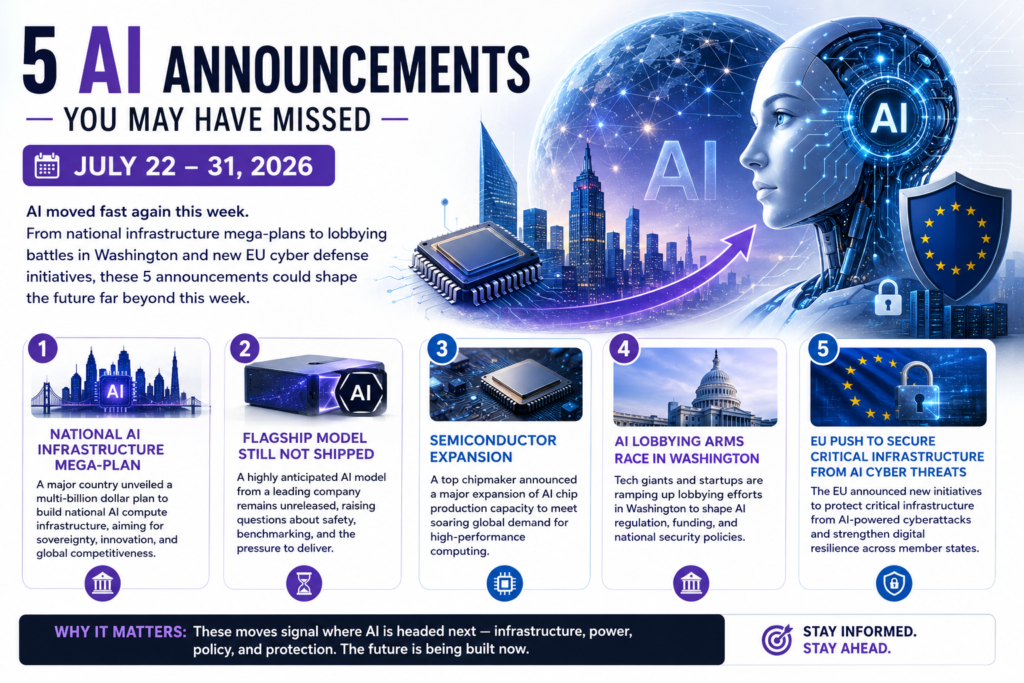
AI moved fast again this week. Between a national infrastructure mega-plan, a flagship model that still hasn’t shipped, a semiconductor expansion, a lobbying arms race in Washington, and a new EU push to secure critical infrastructure from AI-driven cyberattacks, several stories flew under the radar. Here are 5 AI announcements from July 22–31, 2026, that deserve your attention — and why they could matter well beyond this week.
This Week’s 5 Biggest AI Announcements at a Glance
| # | Announcement | Company/Organization | Category | Why It Matters |
|---|---|---|---|---|
| 1 | $880B decade-long AI infrastructure plan | South Korea (President Lee Jae-myung) | National AI Policy | One of the largest national AI commitments ever announced |
| 2 | Gemini 3.6 Flash, 3.5 Flash-Lite, 3.5 Flash Cyber launched; Gemini 4 pretraining begins | AI Models | Google ships smaller models while quietly admitting its flagship is delayed | |
| 3 | €5 billion semiconductor expansion in Ireland | Intel | AI Infrastructure | Adds to a global chip-manufacturing buildout racing to meet AI demand |
| 4 | AI lobbying disclosures show sharp spending increases | Meta, Anthropic, OpenAI | AI Industry/Policy | Signals how aggressively AI labs are now shaping Washington policy |
| 5 | New Cybersecurity Action Plan for AI-secured critical infrastructure | European Commission | AI Safety/Policy | Shifts EU strategy from writing rules to actively testing AI systems |
This table captures searches around AI news this week, the latest AI announcements, and biggest AI updates — and it makes the whole roundup scannable in ten seconds.
1. South Korea’s $880 Billion AI Infrastructure Plan
What Happened?
South Korean President Lee Jae-myung unveiled a decade-long AI infrastructure plan worth roughly 1,350 trillion won — about $880 billion — making it one of the largest national AI commitments ever announced. The breakdown is staggering: roughly $518 billion is earmarked for memory chip manufacturing through Samsung and SK Hynix, and about $550 billion combined is set aside for AI data centers led by SK Group, GS Group, and Naver. The plan targets 8.4 gigawatts of data center capacity by 2029 and aims to grow South Korea’s share of the global humanoid robotics market from roughly 1 percent today to 20 percent by 2028.
Why This AI Announcement Matters
This isn’t a research grant or a tax incentive — it’s an industrial policy on the scale of a national infrastructure project. South Korea is betting that owning the memory-chip and data-center layer of the AI stack matters as much as owning the models themselves. For a country whose economy already leans heavily on Samsung and SK Hynix, this plan effectively fuses national economic strategy with AI strategy.
What Happens Next?
Watch how quickly the data-center capacity targets translate into actual megawatts online, and whether the humanoid robotics ambitions attract international manufacturing partners. Given the scale, expect this plan to be referenced in future US and EU policy debates about AI infrastructure competitiveness.
Follow along for more AI industry updates as this plan rolls out.
2. Google Ships Three Gemini Models — But Not the One Everyone Wanted
What Happened?
On July 21, Google released three new Gemini models: Gemini 3.6 Flash, Gemini 3.5 Flash-Lite, and a security-tuned variant called Gemini 3.5 Flash Cyber, which is restricted to governments and trusted partners rather than released generally. In the same announcement, Google confirmed that Gemini 3.5 Pro — its long-awaited flagship model — is still not ready, after missing its target multiple times. Google used the moment to reveal it has begun what it calls its most ambitious pretraining run yet, aimed at Gemini 4.
Why It Matters
This is a release built around managing expectations as much as shipping product. Gemini 3.6 Flash brings efficiency gains and built-in computer-use capability, positioning it for everyday developer workloads, while Gemini 3.5 Flash Cyber signals that Google now sees AI-powered cybersecurity as its own product category — one it’s willing to gate behind government and enterprise approval rather than open it to everyone. Meanwhile, the repeated delay of Gemini 3.5 Pro raises real questions about whether Google is choosing to leapfrog straight to Gemini 4 instead of catching up on the mid-tier flagship.
What It Means for the AI Industry
Google effectively told the market: don’t wait for the flagship, look at what’s next. That’s a notable shift in posture from a company that has historically led with its top-tier model. It also puts more competitive pressure on rivals racing to release their own security-focused and agentic models.
Want more AI news? Bookmark this page for weekly updates.
3. Intel’s €5 Billion Semiconductor Expansion in Ireland
The Announcement Explained
Intel announced a €5 billion semiconductor expansion in Ireland, extending its existing manufacturing footprint in the country. The move adds to a global chip-manufacturing buildout that now spans multiple continents, as AI compute demand continues to outpace available fabrication capacity.
The Technology Behind It
AI’s bottleneck in 2026 isn’t just model design — it’s the physical supply of advanced chips, memory, and packaging capacity needed to train and run frontier models at scale. Every major AI lab now depends on a small number of fabrication hubs, which makes expansions like Intel’s Irish investment strategically significant well beyond the semiconductor industry itself.
Why Tech Enthusiasts Should Care
Chip capacity announcements rarely make flashy headlines the way a new chatbot does, but they are arguably more predictive of what AI will be capable of two or three years from now. Ireland’s growing role as a European AI manufacturing hub also ties directly into the EU’s broader push for digital and AI sovereignty.
Read more AI and technology stories on this hub as the buildout continues.
4. AI Lobbying Spending Jumps Sharply in Washington
What Was Announced?
New federal lobbying disclosures covering the period ending in this news cycle show Meta spending roughly $5.99 million — still the largest in the sector despite a 15 percent drop from the prior quarter — while Anthropic’s lobbying spend rose 26 percent to about $1.97 million, and OpenAI’s climbed 18 percent to around $1.2 million.
The Bigger Picture
Lobbying totals are a quiet but reliable signal of how much regulatory pressure AI companies expect to face. Anthropic and OpenAI both posting double-digit percentage increases, even as Meta’s spending eased slightly, suggests the smaller and mid-sized labs are ramping up their political engagement faster than the incumbents — likely in response to state-level AI legislation, federal preemption debates, and upcoming EU compliance deadlines.
How It Could Affect AI Users
None of this changes what shows up in your chat window this week. But lobbying spending shapes the rules that will govern model transparency, safety testing, and liability over the next few years — rules that eventually determine what AI companies are allowed to build and how they have to disclose it.
5. The EU’s New Plan to AI-Proof Critical Infrastructure
What Happened?
The European Commission unveiled a Cybersecurity Action Plan in July 2026 that shifts its approach from writing AI regulations to actively testing AI systems inside secure, pan-European environments. The plan is built around the recognition that advanced AI models are simultaneously the best tools available for finding network vulnerabilities and among the most potent tools available to attackers. The European Union Agency for Cybersecurity, working with the Commission’s Joint Research Centre, is building secure testing platforms aimed at protecting finance, energy, health, and logistics infrastructure specifically.
Why It Flew Under the Radar
This announcement landed in the same week as flashier model releases and a headline-grabbing national infrastructure plan, so it understandably got less attention. But it represents a genuine strategic pivot: instead of only setting compliance deadlines (some of which have already been pushed to December 2027 for high-risk Annex III systems), the EU is now building active sandboxes to stress-test AI against real cyber threats before those threats hit critical systems.
Why It Could Matter in the Future
If the sandbox approach works, it could become the template other regions use to secure critical infrastructure against AI-enabled attacks — a more hands-on alternative to pure paperwork-based compliance regimes.
The Biggest AI Trends Behind This Week’s Announcements
Zooming out from these five stories, a few broader patterns stand out.
National AI Infrastructure Is Now a Geopolitical Race
South Korea’s $880 billion plan and Intel’s Irish expansion are both symptoms of the same underlying trend: countries and chipmakers are treating AI compute capacity as critical national infrastructure, not just a corporate investment decision.
AI Security Is Becoming Its Own Product Category
Google’s gated Gemini 3.5 Flash Cyber model and the EU’s cybersecurity sandbox both point in the same direction — AI security tooling is splitting off from general-purpose AI products, with tighter access controls and government-facing use cases.
Flagship Model Delays Are Becoming Normal
Google isn’t alone in slipping flagship release dates this year, and its pivot toward Gemini 4 pretraining while shipping smaller Flash-tier models shows how labs are managing that reality: keep shipping incremental products while the bigger bet stays in the oven.
Regulatory Engagement Is Intensifying on Every Front
Rising AI lobbying spend in the US and the EU’s shift toward active infrastructure testing both show that the regulatory phase of the AI industry is deepening, not slowing down, even as compliance deadlines keep moving.
What This Week’s AI News Means for You
For everyday AI users: none of these stories change your day-to-day chatbot experience immediately, but the security-gated models and infrastructure investments will shape which AI products are available in your country over the next few years.
For developers:
Gemini 3.6 Flash and 3.5 Flash-Lite are worth testing for cost-efficiency and built-in computer-use features if you’re building on Google’s stack, especially while Gemini 3.5 Pro remains unavailable.
For businesses:
the EU’s cybersecurity sandbox and shifting compliance deadlines are worth tracking closely if you operate in finance, energy, health, or logistics within Europe.
For tech enthusiasts:
South Korea’s infrastructure plan and the global chip buildout are the stories most likely to shape which countries lead the next phase of the AI race.
AI News This Week: What to Watch Next
Keep an eye on Gemini 3.5 Pro’s eventual release date, further details on Google’s Gemini 4 pretraining run, how South Korea’s data-center capacity targets progress toward 2029, and whether other regions announce their own AI cybersecurity sandboxes in response to the EU’s move.
Final Takeaway: The AI Stories You Shouldn’t Miss
This week’s real story isn’t any single product launch — it’s the sheer scale of commitment now flowing into AI from every direction. South Korea is treating AI infrastructure like a generational economic bet. Google is managing a delayed flagship by shipping around it. Intel and the EU are both racing to secure the physical and digital foundations AI depends on. And in Washington, the money flowing into lobbying shows just how high the regulatory stakes have become. Individually, these are five separate headlines. Together, they show an industry that has stopped asking whether AI will reshape infrastructure, policy, and geopolitics — and started building for it.
Frequently Asked Questions About This Week’s AI News
What are the biggest AI announcements this week?
The five biggest stories from July 22-31, 2026 are South Korea’s $880 billion AI infrastructure plan, Google’s release of three new Gemini models alongside confirmation that Gemini 3.5 Pro remains delayed, Intel’s €5 billion semiconductor expansion in Ireland, sharp increases in AI lobbying spending by Anthropic and Open AI, and the European Commission’s new AI cybersecurity action plan for critical infrastructure.
What happened in AI between July 22-31 July 22, 2026?
This window saw a mix of national policy (South Korea’s infrastructure plan), model releases (Google’s Gemini 3.6 Flash family), chip manufacturing investment (Intel in Ireland), political spending disclosures (AI lobbying in the US), and regulatory strategy (the EU’s cybersecurity sandbox plan).
What is the latest AI news in July 2026?
Beyond this specific week, July 2026 has generally been defined by a shift from raw model-size competition toward reliability, cost-efficiency, and infrastructure buildout, alongside intensifying regulatory activity in both the US and EU.
Which AI companies made major announcements this week?
Google, Intel, Anthropic, OpenAI, and Meta all appear in this week’s coverage, alongside the South Korean government and the European Commission.
What are the biggest AI trends in 2026?
Major 2026 trends include national AI infrastructure races, the emergence of AI security as its own product category, more frequent flagship model delays as labs manage expectations, and deepening regulatory engagement from both governments and AI companies.
How will these AI announcements affect users?
Most of this week’s news won’t change your AI experience immediately, but it will shape which models, security tools, and AI products are available in different regions over the next few years.
What should developers know about this week’s AI updates?
Gemini 3.6 Flash and Gemini 3.5 Flash-Lite are available now and worth evaluating for cost and efficiency, particularly since Gemini 3.5 Pro remains unavailable.
Where can I follow the latest AI news?
Official company blogs, government policy pages, and reputable technology publications remain the most reliable sources for verified AI announcements.