

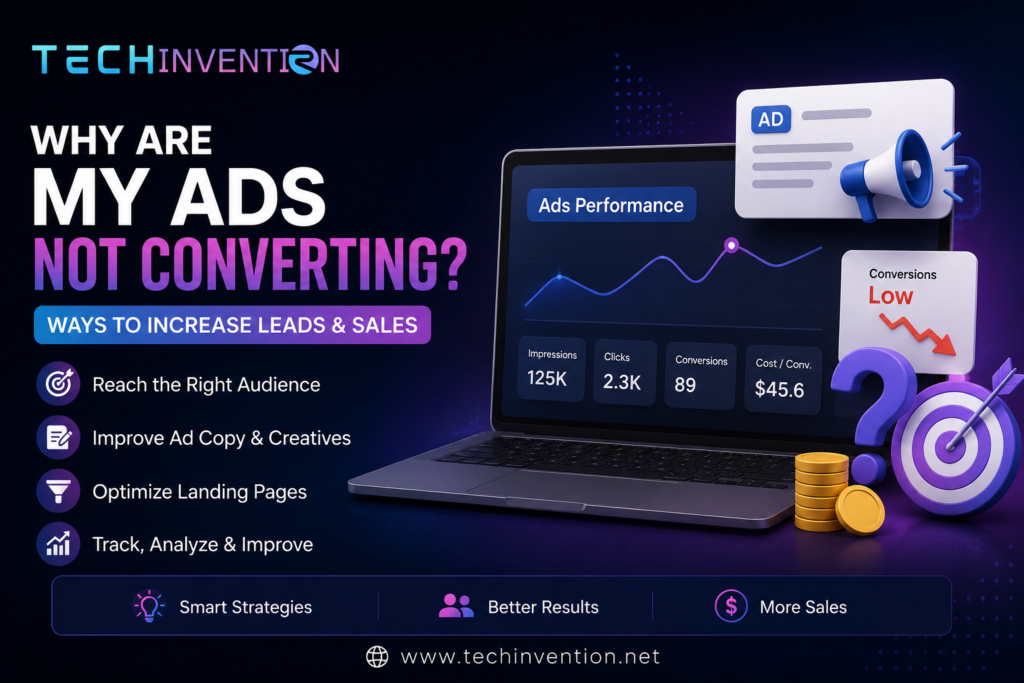
Your advertising dashboard shows impressions. People are clicking. Your budget keeps shrinking. Yet your inbox, sales pipeline, and online store remain painfully quiet.
This leads to one frustrating question: Why are my ads not converting?
The answer is rarely a single bad keyword or weak image. Low-conversion-rate ads usually result from a broken connection between audience targeting, search intent, ad copy, landing page experience, conversion tracking, and follow-up.
A campaign can attract hundreds of visitors and still produce no sales when it reaches the wrong people. It can also fail when the offer is confusing, the website loads slowly, or the tracking system sends inaccurate data back to the advertising platform.
This guide explains 15 proven ways to identify PPC conversion problems, improve ad conversion rate, lower cost per acquisition, and generate more qualified leads in 2026.
What Does It Mean When Ads Are Not Converting?
An ad fails to convert when users click or view it but do not complete the intended action. That action might be:
- Purchasing a product
- Booking an appointment
- Requesting a quotation
- Completing a lead form
- Calling the business
- Registering for a trial
- Downloading a resource
Clicks alone do not indicate success. A high click-through rate may look encouraging, but it has little business value when those clicks never become customers.
The real performance indicators are conversion rate, cost per conversion, lead quality, cost per acquisition, revenue, and ROAS. These metrics show whether your advertising is producing profitable business outcomes instead of empty traffic.
The Most Common Reasons Ads Fail
Most digital advertising mistakes fall into five categories:
- The campaign targets people who are unlikely to buy.
- The advertisement does not match the user’s intent.
- The landing page creates friction or distrust.
- Conversion tracking provides incomplete or inaccurate data.
- The campaign is not tested and improved consistently.
Before increasing your budget, complete a PPC audit. More spending will not repair a weak sales funnel. It will only send more paid traffic into the same broken customer journey.
| Common mistake | What happens | Recommended fix |
|---|---|---|
| Broad audience targeting | Budget is spent on low-intent users | Refine demographics, locations, interests and exclusions |
| Informational keywords | Users research but do not buy | Focus on commercial and transactional search intent |
| Generic ad copy | Ads fail to create relevance or urgency | Match the headline to the customer’s problem |
| Weak landing page | Visitors leave without taking action | Improve message consistency, trust and usability |
| Missing tracking | Platforms optimize toward incomplete data | Verify Google Ads, GA4, GTM and Meta Pixel events |
| Slow mobile website | Users abandon the page | Improve speed and mobile optimization |
| No remarketing | Interested visitors are lost | Create remarketing campaigns by customer stage |
| No testing | Weak elements remain active | Run structured A/B testing on one variable at a time |
Poor Audience Targeting
A campaign cannot convert consistently when it reaches people who do not need, trust, or qualify for the offer.
Poor audience targeting often includes locations outside the service area, irrelevant age groups, existing customers, job seekers, competitors, or users with weak purchasing intent.
Target the Right Audience
Start by examining who already becomes a profitable customer. Identify their location, problems, buying triggers, job role, device usage, objections, and average order value.
For Meta Ads optimization, test separate audiences rather than combining every interest into one ad set. Compare broad targeting, customer lists, website visitors, engaged social users, and relevant lookalike audiences.
For Google Ads, review location settings, device reports, audience segments, search terms, and time-of-day performance. Exclude areas or segments that repeatedly consume budget without generating qualified enquiries.
Weak Landing Pages
Your advertisement creates a promise. Your landing page must fulfil it immediately.
When the ad promotes a free consultation but the visitor reaches a generic homepage, the customer must search for the promised service. Every extra decision creates friction.
Optimize Your Landing Page
High-converting landing pages normally focus on one audience, one offer, and one primary call-to-action. The headline should reflect the advertisement that brought the visitor to the page.
To improve landing page conversions:
- Place the main benefit above the fold.
- Use a specific and visible call-to-action.
- Remove unnecessary navigation.
- Keep forms short.
- Explain what happens after submission.
- Add testimonials, guarantees, credentials, or case studies.
- Address the customer’s main objection.
- Repeat the CTA after important sections.
Landing page optimization is not limited to changing button colours. It requires improving the complete path from visitor expectation to completed action.
Low Quality Ad Copy
Generic advertising attracts generic traffic. Statements such as “quality service,” “trusted company,” or “contact us today” do not explain why a customer should choose your business.
Improve Your Headlines
A strong headline connects the user’s problem to a clear result. It should communicate relevance before attempting cleverness.
Compare these examples:
Weak: Professional Marketing Solutions
Stronger: Reduce Wasted Google Ads Spend and Generate Qualified Leads
The stronger version identifies the platform, the problem, and the desired outcome. It is more likely to attract decision-makers who need Google Ads conversion optimization.
Add Strong Call-to-Actions
Your call-to-action should explain the next step clearly. Replace vague phrases such as “Learn More” with actions connected to the offer:
- Request Your PPC Audit
- Get a Custom Advertising Plan
- Book a Campaign Review
- Check Your Lead Generation Costs
- Speak With Google Ads Experts
Avoid false urgency or exaggerated promises. Clear expectations produce better leads than aggressive wording that attracts unqualified clicks.
Wrong Keywords
One of the biggest reasons why ads get clicks but no sales is a mismatch between the keyword and the offer.
A person searching “how does business insurance work?” is probably researching. Someone searching “business insurance quote near me” is much closer to making a decision.
Remove Negative Keywords
Review the actual search terms that triggered your ads. Add negative keywords for irrelevant searches involving terms such as:
- Free
- Jobs
- Salary
- Course
- Definition
- Template
- DIY
- Used
- Customer service
The correct exclusions depend on your business. A training provider may want “course,” while a service company may need to exclude it.
Keyword match types also require regular monitoring. Broad match can discover valuable searches, but it can also expose a weak account to irrelevant traffic when conversion data, negative keywords, and campaign controls are inadequate.
Missing Conversion Tracking
Campaign optimization becomes guesswork when your tracking system cannot distinguish between a valuable sale and a meaningless page visit.
Install Conversion Tracking
Track the actions that directly support business growth, including purchases, qualified forms, calls, bookings, subscriptions, and revenue.
A dependable measurement setup may include:
- Google Ads conversion tracking
- Google Analytics
- Google Tag Manager
- Meta Pixel
- Meta Conversions API
- CRM or offline conversion imports
- Call tracking
Google Tag Manager allows marketers to manage measurement tags and related code without repeatedly changing the website’s source code. Google also recommends testing implementation through preview and diagnostic tools. (Google Help)
For Meta advertising, the Pixel and Conversions API can work together to improve measurement across the customer journey. (Facebook)
Test every event yourself. Submit the form, make a test purchase, click the phone number, and verify that each action appears once with the correct value.
Slow Website Speed
Paid traffic is expensive. Sending it to a slow website wastes both attention and budget.
Increase Website Speed
Compress large images, remove unnecessary scripts, use effective caching, improve hosting, reduce redirects, and delay non-critical resources.
Test the actual landing page rather than relying only on homepage performance. Advertising visitors may reach a page containing extra tracking scripts, videos, form tools, or third-party widgets that create delays.
Speed improvements should be evaluated alongside conversion data. A faster website is useful, but speed alone will not repair an irrelevant offer.
Poor Mobile Experience
A page can look polished on a desktop and still be nearly unusable on a phone.
Improve Mobile User Experience
Check whether mobile users can read the headline, tap buttons, complete forms, select fields, and call the business without zooming or scrolling unnecessarily.
Pay particular attention to:
- Button size and spacing
- Form length
- Sticky banners
- Pop-ups
- Menu behaviour
- Text readability
- Payment options
- Image dimensions
Mobile optimization should support the action, not simply make the design fit a smaller screen.
Low Trust Signals
Customers hesitate when a business asks for money or personal information without demonstrating credibility.
Build Customer Trust
Add trust elements near the point where visitors make decisions. These may include verified reviews, recognisable client logos, team information, physical contact details, qualifications, secure payment indicators, privacy information, clear guarantees, or relevant case studies.
Do not rely on vague claims such as “number one company” unless they can be proven. Specific evidence is more persuasive than unsupported superlatives.
A case study stating what was changed, how performance was measured, and what limitations applied will usually carry more weight than a page filled with generic praise.
Incorrect Campaign Objectives
Advertising platforms optimize delivery according to the objective and conversion event you select.
A traffic campaign is designed primarily to attract visits. A sales or lead-focused campaign should be configured around meaningful conversion actions. Meta distinguishes between traffic-focused delivery and sales campaigns designed to optimize toward actions such as registrations, checkouts, or purchases. (Facebook)
Choose the objective closest to the business outcome. Do not optimize for landing page views when the real goal is a qualified consultation.
Poor Budget Allocation
Spreading a limited budget across too many campaigns creates weak data and prevents any single campaign from learning effectively.
Move budget toward campaigns, locations, devices, audiences, products, and search terms that generate profitable outcomes. Reduce spending where cost per conversion remains high and lead quality remains low.
Budget optimization does not mean automatically funding the campaign with the most conversions. Compare revenue, profit margin, sales acceptance rate, and lifetime value.
A campaign generating 20 poor leads may be less valuable than one generating five high-intent enquiries.
Lack of Remarketing
Many customers do not convert during their first visit. They compare providers, ask colleagues, check reviews, or wait for the right time.
Run Retargeting Campaigns
Build remarketing campaigns for meaningful audience groups:
- Product viewers who did not purchase
- Form visitors who did not submit
- Cart abandoners
- Video viewers
- Previous customers
- High-value page visitors
- Leads who did not book
Match the message to the customer journey. A first-time visitor may need education. A cart abandoner may need reassurance. A previous customer may respond to a complementary offer.
Exclude users who have already completed the desired action unless repeat purchases are part of the strategy.
No A/B Testing
Changing several elements at once may alter results, but it does not reveal what caused the improvement.
Test Different Creatives
Run controlled A/B testing ads by changing one major variable at a time:
- Headline
- Main image
- Video opening
- Offer
- CTA
- Landing page
- Form length
- Audience
- Proof element
Set a clear hypothesis before launching the test. For example: “Showing the starting price will reduce low-quality leads and improve the sales acceptance rate.”
Judge the result using meaningful outcomes rather than CTR alone. A creative that receives fewer clicks may still generate more profitable customers.
How to Improve Google Ads Conversion Rate
When evaluating why Google Ads are not converting, begin with search intent and measurement—not bidding.
Google describes Quality Score as a diagnostic tool scored from 1 to 10. It reflects expected click-through rate, ad relevance, and landing page experience, but it should not be treated as the campaign’s primary KPI or as a direct input in the auction. (Google Help)
Use Smart Bidding
After confirming accurate conversion tracking, consider an appropriate Smart Bidding strategy. Google’s conversion-focused options include Target CPA, Target ROAS, Maximize Conversions, and Maximize Conversion Value.
Google began updating some Smart Bidding labels in June 2026, but the underlying bidding behaviour did not change. (Google Help)
Do not treat Smart Bidding as an automatic repair tool. Poor conversion data, weak offers, and low-quality leads will teach the system to pursue the wrong outcomes.
Track ROAS
Revenue-generating campaigns should measure return on ad spend rather than counting every conversion equally.
Use this formula:
ROAS = Revenue attributed to advertising ÷ Advertising cost
For lead generation, connect advertising data with the CRM. Track which leads become appointments, proposals, customers, and revenue.
Optimize for Lead Quality
Separate qualified leads from spam, duplicate enquiries, irrelevant calls, and users outside your service area.
Where possible, send offline outcomes back to Google Ads. This helps campaign optimization focus on leads that create business value rather than forms that are easy to submit.
Analyze Campaign Reports Weekly
Review:
- Search terms
- Conversion actions
- Cost per conversion
- Impression share
- Device performance
- Location performance
- Ad relevance
- Landing page results
- Lead quality
- ROAS
Avoid making daily decisions based on small fluctuations. Look for repeated patterns with enough data to support action.
How to Improve Facebook Ads Conversion Rate
When investigating why Facebook Ads are not converting, examine the offer, creative, objective, audience, and event setup.
Google Search often captures existing demand. Meta Ads frequently interrupt people who were not actively searching. The Meta advertisement must therefore create enough interest, relevance, and trust to move the user forward.
| Conversion issue | Google Ads | Facebook and Meta Ads |
|---|---|---|
| Main intent problem | Keyword does not match purchasing intent | Audience is not interested or ready |
| Common creative problem | Headline does not match the search | Image or video fails to stop attention |
| Typical setup mistake | Wrong keywords or search terms | Wrong campaign objective or event |
| Tracking priority | Google tag, GTM, GA4 and conversion actions | Meta Pixel, Conversions API and event quality |
| Landing page concern | Poor message match with keyword and ad | Weak continuation from creative to page |
| Optimization focus | Search intent, negative keywords and bid strategy | Offer, creative testing and audience signals |
| Remarketing opportunity | Previous site visitors and search users | Engaged viewers, visitors, leads and customers |
For stronger Facebook Ads optimization:
- Use a sales or leads objective when conversions are the goal.
- Test multiple creative concepts, not only minor design changes.
- Show the product or result quickly.
- Match the landing page headline to the advertisement.
- Verify Meta Pixel events.
- Use the Conversions API where appropriate.
- Exclude existing customers when acquiring new ones.
- Test retargeting separately from cold audiences.
- Monitor lead quality inside the CRM.
Step-by-Step Ad Campaign Optimization Checklist
Use this checklist when paid ads are not generating leads:
Measurement
- Confirm every important conversion action.
- Test forms, calls, purchases and booking events.
- Check for duplicate conversion events.
- Verify Google Tag Manager and Meta Pixel implementation.
- Connect ad data with CRM or sales outcomes.
Targeting and Intent
- Review search terms and keyword match types.
- Add negative keywords.
- Exclude irrelevant locations and audiences.
- Separate cold, warm and remarketing audiences.
- Confirm that the campaign objective matches the business goal.
Advertising
- Match each headline to the customer’s problem.
- Explain the benefit clearly.
- Add a specific call-to-action.
- Test different offers and creative concepts.
- Pause advertisements that generate poor-quality traffic.
Landing Page and CRO
- Maintain message consistency between ad and page.
- Place the primary CTA above the fold.
- Reduce unnecessary form fields.
- Add trust signals.
- Test the page on multiple mobile devices.
- Improve website speed.
- Remove distracting links and pop-ups.
Profitability
- Track cost per acquisition.
- Calculate ROAS.
- Compare lead quality by campaign.
- Reallocate budget using profit, not clicks.
- Review campaign reports every week.
Professional PPC Management by Tech Invention
Fixing low-conversion-rate ads requires more than changing a headline or increasing the daily budget. It demands coordinated work across targeting, analytics, advertising, landing pages, CRO, SEO, and lead generation strategy.
Tech Invention provides:
- PPC Management Services
- Google Ads Management Services
- Meta Ads Management
- Facebook Ads Optimization
- Conversion Rate Optimization
- Landing Page Optimization
- Google Ads Audits
- Lead Generation Services
- Search Engine Optimization
- Campaign Tracking and Reporting
As a digital marketing agency for PPC, Tech Invention can audit the complete customer journey—from the first impression to the final sale.
Businesses comparing Google Ads experts, Facebook Ads specialists, a PPC management company, or the best PPC agency should look beyond promises of cheap clicks. The right partner should explain where the budget is going, which leads become customers, and how campaign decisions affect profitability.
Stop paying for traffic that does not produce business results. Contact Tech Invention for a complete PPC audit and a practical campaign optimization plan.
Frequently Asked Questions
Why are my Google Ads getting clicks but no conversions?
Your keywords may be attracting research-based searches instead of buyers. Other causes include weak landing pages, unclear offers, irrelevant search terms, poor mobile usability, or broken conversion tracking. Review search intent, negative keywords, landing page behaviour, and actual lead quality before increasing bids.
Why are my Facebook Ads not generating leads?
Meta Ads may fail when the audience is too broad, the creative does not capture attention, the campaign uses the wrong objective, or the offer lacks relevance. Check the Meta Pixel, conversion event, audience exclusions, landing page consistency, and mobile form experience.
How can I improve my ad conversion rate?
Improve the connection between the audience, advertisement, offer, and landing page. Track meaningful actions, remove irrelevant traffic, strengthen the CTA, reduce page friction, add trust signals, and run controlled A/B tests.
Does landing page speed affect conversions?
Yes. A slow page creates friction and can cause visitors to leave before seeing the offer or completing the form. Improve image sizes, hosting, scripts, caching, mobile performance, and third-party widgets. Speed should be improved alongside message relevance and usability.
Why is my cost per conversion so high?
A high cost per conversion may result from expensive keywords, weak targeting, poor conversion tracking, low landing page performance, strong competition, or an offer that does not persuade users. Compare cost per conversion with lead quality, customer value, and profit before deciding whether the cost is unacceptable.
How do I know if my ads are targeting the wrong audience?
Warning signs include high traffic with little engagement, enquiries outside your service area, low-quality leads, irrelevant search terms, poor sales acceptance rates, and repeated clicks from groups that never buy. Segment performance by location, device, search term, demographic, and audience.
What is a good conversion rate for Google Ads?
There is no universal conversion rate that applies to every business. Performance varies by industry, offer, device, location, sales cycle, and conversion type. A useful conversion rate produces qualified customers at a profitable acquisition cost.
Should I hire a PPC agency to optimize my campaigns?
A PPC agency may be valuable when tracking is unreliable, the account is complex, internal resources are limited, or advertising costs are rising without clear business results. Choose an agency that measures revenue and lead quality rather than reporting only impressions and clicks.
How long does ad campaign optimization take?
Some tracking and landing page problems can be fixed immediately. Reliable performance improvements require enough conversion data to identify patterns and test changes. Avoid judging campaigns too quickly, but do not allow obvious tracking errors or irrelevant traffic to continue unchecked.
Can SEO and paid advertising work together?
Yes. SEO reveals valuable topics, queries, landing pages, and customer questions, while PPC provides faster testing of offers and keywords. Combining both channels can strengthen search visibility, improve landing page relevance, and reduce dependence on a single traffic source.
Final Thoughts
When asking, “Why are my ads not converting?”, do not assume the advertising platform is the only problem.
Start with the complete conversion system:
- Are you reaching people with the right intent?
- Does the advertisement communicate a relevant benefit?
- Does the landing page continue the same message?
- Can visitors trust the business?
- Is the website fast and mobile-friendly?
- Are conversions measured accurately?
- Are you optimizing for customers rather than cheap clicks?
The strongest campaigns align audience targeting, search intent, ad relevance, conversion tracking, user experience, remarketing, and sales follow-up.
Before spending another dollar, audit the entire journey. Fix the measurement system, remove wasted traffic, strengthen the offer, and test improvements methodically.
Tech Invention helps businesses turn underperforming campaigns into measurable lead-generation and sales systems. Contact our online advertising experts for Google Ads management, Facebook Ads management, conversion rate optimization, landing page optimization, SEO, and performance-focused digital marketing services.