

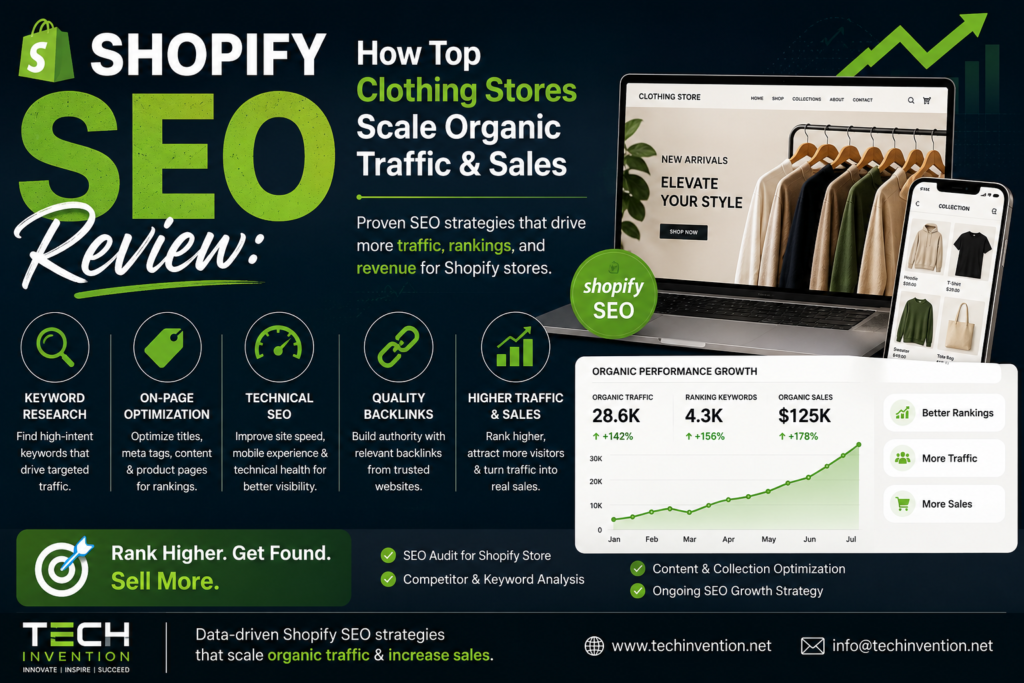
A Shopify clothing store can look polished and still struggle to attract buyers from Google. Strong images matter, but growth also needs clear site architecture, useful product content, fast mobile pages, smart internal links, and a brand message shoppers can trust.
This Shopify SEO review for clothing stores explains what successful apparel websites do differently. No SEO plan can guarantee a first-page position. However, a well-built store gives Google clearer signals and shoppers a better buying experience. This creates a stronger base for growth. It also gives teams a practical roadmap for deciding which technical, content, and conversion improvements should receive attention first during growth.
What Is a Shopify SEO Review?
A Shopify SEO review is a full audit of a fashion store’s technical setup, product pages, collection structure, content, and conversion path. It finds slow pages, duplicate content, weak keywords, indexing problems, and user experience issues that may limit traffic and sales.
The review checks how search engines discover the store and what visitors do after landing. SEO attracts qualified users, while Conversion Rate Optimization, or CRO, helps turn them into customers.
Shopify creates canonical tags, sitemap files, robots.txt files, and title tag support. Owners must still check how themes, apps, product data, and content use these features.
Why Clothing Stores Need a Focused SEO Strategy
Fashion SEO must connect product discovery, visual appeal, sizing confidence, seasonal demand, and brand positioning.
Clothing shoppers often use detailed searches such as “linen summer dress for wedding guest” or “petite wide-leg trousers.” These long-tail fashion keywords show clear needs and may attract users who are closer to buying.
A strong best Shopify clothing stores SEO strategy maps broad searches to collection pages and detailed searches to products, guides, and trend reports.
Build a Clear Collection Page Hierarchy
The best structure moves from broad categories to focused collections and then to products.
For example:
Women’s Clothing → Dresses → Summer Dresses → Linen Midi Dress
This path helps shoppers browse and gives search engines a route to important pages. Google says internal links help it find pages, understand relevance, and judge which pages are more important.
Each collection page should target one search theme. Avoid several collections that serve the same intent unless each offers a different range.
Link to related collections, guides, and selected products. This internal linking structure supports discovery without forced keywords.
Follow Shopify Product Page SEO Best Practices
A strong product page answers buying questions and gives search engines clear product details.
Use a descriptive title. “Mia Women’s Linen Two-Piece Summer Set” gives more context than “The Mia.” Write an original description instead of copying supplier text. Explain the fabric, fit, care, use, and key details in plain language.
A useful page should include:
- Main features and benefits
- Fabric and care instructions
- Fit notes and model measurements
- A clear sizing guide and user experience
- Delivery and return information
- Reviews and related products
Add accurate Product schema markup for price, stock status, ratings, and shipping details. Google says product structured data can make this information eligible for richer search appearances. Shopify also provides structured data tools for product and article objects.
Product description optimization should help a buyer decide, not repeat keywords.
Manage Duplicate URLs and Product Variants
Canonical URLs help search engines choose the main page when similar versions exist.
Fashion stores can create several paths to one product through collections, filters, tracking links, colors, and sizes. Shopify adds canonical tags automatically, but owners should inspect product canonical URLs after theme changes or app installations.
Do not make every color or size indexable unless it has separate demand, unique content, and a useful landing experience. Google recommends a clear ProductGroup relationship and consistent canonical setup for variants.
When a product disappears, redirect its URL to the closest replacement or relevant collection. Shopify supports redirects when addresses change.
Improve Mobile Speed and Core Web Vitals
Ecommerce mobile optimization for fashion brands means fast pages, stable layouts, simple navigation, and easy buying actions.
Large images, autoplay videos, pop-ups, review apps, tracking scripts, and unused theme code can slow a store. Test real collection and product pages, not only the homepage.
Compress images, remove low-value apps, limit heavy animation, delay below-the-fold media, and keep buttons stable while pages load. Filters, size selectors, and checkout buttons must work well on small screens.
Core Web Vitals measure real-world loading, interaction, and visual stability. Google recommends good scores but states that strong Core Web Vitals alone do not guarantee top rankings.
A high-converting Shopify apparel website design helps people find, compare, trust, and buy products with less effort.
Use Product Images as Search Assets
Fashion images should show products clearly and include useful filenames, nearby text, and alt text.
Replace “IMG_4472.jpg” with “women-black-linen-midi-dress-front.jpg.” Write alt text that describes the image. Do not paste the same keyword into every image.
Google recommends descriptive filenames and alt text and advises placing images near relevant content. Shopify also lets merchants add alt text to product media.
This reduces doubt and supports CRO.
Build Authority With Fashion Content Marketing
Shopify fashion brand content marketing should answer real customer questions before and after a purchase.
Do not publish random posts only because a keyword tool shows volume. Build content clusters around collections, products, materials, occasions, and customer needs.
A modest fashion store could publish guides on layering, warm-weather fabrics, styling, sizing, and garment care. A streetwear store could cover hoodie weights, fit comparisons, seasonal drops, and sneaker pairing.
Useful formats include buying guides, trend reports, fabric explainers, gift guides, style comparisons, and seasonal checklists. Each article should link naturally to a matching collection or product.
This can grow non-brand organic traffic and connect the brand with its products, buyers, styles, materials, and occasions.
Common Shopify SEO Mistakes to Avoid
The worst mistakes usually involve duplication, weak targeting, poor app control, and shallow content.
Common Shopify SEO mistakes to avoid include copying manufacturer descriptions, leaving collection pages empty, publishing overlapping blogs, using vague titles, hiding key products deep in the site, and installing apps that perform the same task.
Do not treat every page as a keyword target. Cart, account, internal search, and filter pages may not need organic visibility. Review indexation in Google Search Console and find low-value URLs that compete with useful pages.
Do not add schema through several apps without testing it. Duplicate markup can create errors. Avoid changing URLs only to insert keywords. A stable URL with a correct redirect is safer.
How to Scale a Shopify Clothing Website
Scale by improving valuable pages first, then expand into new search demand with clear intent.
Start with this order:
- Fix crawling, indexing, canonical, and redirect problems.
- Improve page speed and mobile usability.
- Strengthen the main collection pages.
- Upgrade top-selling and high-impression product pages.
- Improve links between collections, products, and guides.
- Publish content based on customer questions.
- Measure clicks, rankings, revenue, and conversion rate.
Shopify apparel store optimization should focus on results, not traffic alone. A page with 5,000 visits but no sales may target the wrong intent. A page with 300 qualified visits and strong revenue may deserve more links and better copy.
Review performance monthly. Track non-brand clicks, collection visibility, product engagement, add-to-cart rate, organic sales, and revenue by landing page.
“How Tech Invention ranks your Shopify Clothing Website using SEO”
Finding a fashion or apparel shop on Shopify isn’t just about focusing on broad keywords such as “men’s shirts” or “women’s dresses”–it requires a specific plan designed around the intent of customers shopping online as well as technical optimization and the authority of the topic.
Here’s the way Tech Invention can help you get organic search results and convert high-converting traffic to the site of your Shopify apparel store
1. Liquid Code & Technical Speed Optimization
- Essential Web Vitals boost Liquid themes that typically bloat with scripts for apps that are not needed and high-resolution imagery. Tech Invention cleans unused code, minimizes CSS/JavaScript, and then implements the latest image standards (WebP) to reduce sub-2-second loading times.
- Mobile-First UX: More than 70% of shoppers browse with smartphones. Mobile menus are designed to be clean with intuitive filtering and mobile navigation that is friction-free.
2. High-Intent Keyword Mapping & Category Hierarchy
- Long-Tail Targeting: Instead of rivalry with the fast-fashion giants with broad terms, we target keywords that convert well, with low competition (e.g., “organic cotton oversized hoodies” or “vintage acid-wash graphic tees”).
- Collection page optimization: In e-commerce, collection pages are more popular than individual product pages for products. We create distinct meta descriptions and H1 tags and introductory text that is contextual for each category page.
3. Product Schema & Rich Snippets
- Structured Data implementation: We integrate JSON-LD schemas into our products to show the availability of stock, prices, star ratings, size charts, and color variants right in Google Search Engine Results Pages (SERPs).
- Visual Search & Image SEO: We write descriptive, rich, keyword-rich
alttext and file titles for all images of garments that tap into Google Images and Lens search traffic.
4. Generative Engine Optimization (GEO) & Fashion Content Marketing
- Topical Authority Hubs: The Style Guides we create are style guides, trend reports, along with “How-To-Style” blogs that link directly to your clothes collections.
- AI and Conversational Search Alignment: We design content with specific Q&A blocks as well as bulleted points so that your company’s name is featured within Google AI Overviews, ChatGPT, and Perplexity when shoppers seek out style suggestions.
5. E-Commerce Authority & Backlink Acquisition
- Digital PR and Fashion Outreach: High-quality links are earned from lifestyle magazines, fashion blogs, as well as retail directories, to increase your domain’s authority (DA) sustainably and safely.
Frequently Asked Questions
How Long Does Shopify SEO Take?
Small technical fixes may help quickly, but competitive growth often takes several months. Timing depends on competition, site quality, content depth, product demand, authority, and consistent work.
Is Shopify Good for Clothing Store SEO?
Yes. Shopify includes canonical tags, sitemaps, editable metadata, redirects, and theme support. Strong results still require good structure, content, speed, internal links, and products people want.
Should Every Product Page Target a Keyword?
Every page should match the product and buyer intent. Forcing broad keywords onto many product pages can create overlap. Collection pages suit broad terms, while product pages suit detailed searches.
What Content Should a Fashion Store Publish?
Publish content that helps customers choose, style, size, compare, or care for products. Use customer questions, search data, sales trends, and on-site search terms.
Can SEO Replace Paid Ads?
No. SEO can build long-term visibility, while ads can create faster reach and support launches.
Turn Organic Search Into a Sales Channel
A polished theme is not enough. A clothing store needs strong technical SEO, clear collections, useful product pages, fast mobile performance, accurate schema markup, helpful content, and a simple buying path.
Begin with a complete Shopify SEO review for clothing stores. Find pages that show demand, fix the barriers holding them back, and build a focused plan around sales. Do not chase every keyword. Create the clearest shopping experience for the customers you want to reach.
Ready to scale your Shopify clothing website? Request a professional SEO and CRO audit to uncover technical problems, content gaps, missed keywords, and conversion leaks. Turn organic search into a measurable source of qualified traffic and sales.