

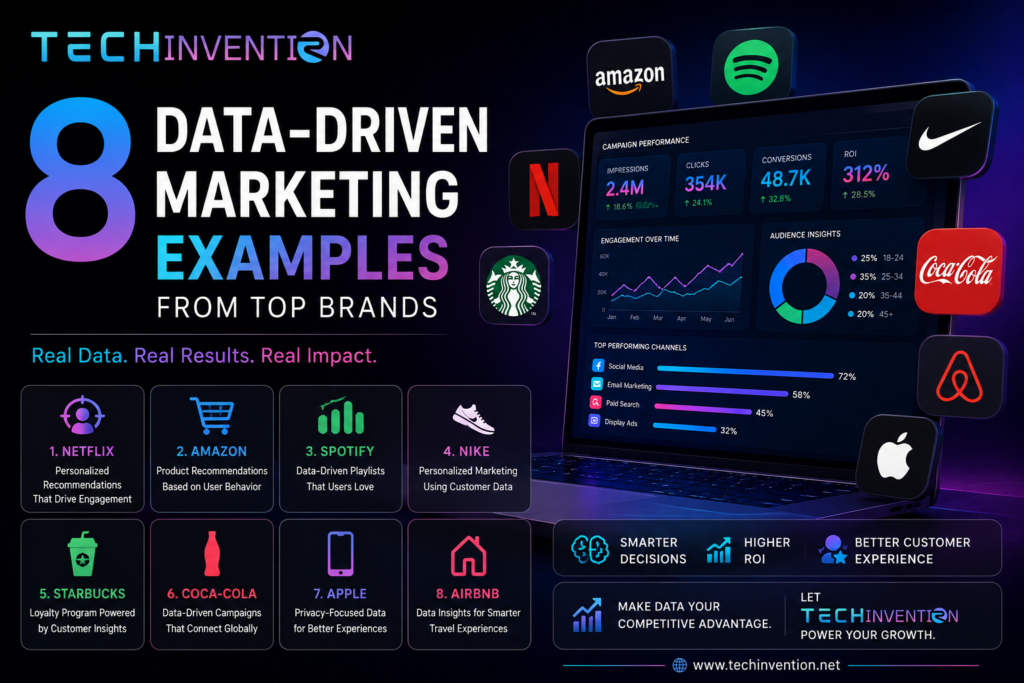
In today’s competitive digital landscape, guesswork is no longer a strategy — it’s a liability. The brands winning market share aren’t just running ads; they’re mining customer data to build smarter campaigns, sharper products, and stickier loyalty loops. This is the essence of data-driven marketing: turning raw signals into decisions that move revenue.
Data-driven marketing isn’t reserved for billion-dollar enterprises. It’s a practical, scalable discipline that lets any brand understand what customers want — often before they ask for it — and deliver experiences that keep them coming back.
In this guide, we break down 8 real-world data-driven marketing examples from category leaders like Netflix, Amazon, and Starbucks. You’ll see the exact data sources they rely on, the tactics they execute, and the measurable outcomes they achieve — all distilled into a blueprint you can apply immediately, whether you’re an early-stage startup or an established enterprise scaling through Foundation, Optimization, and Amplification. Let’s dive in.
1. Netflix’s Personalized Recommendation Engine
Netflix didn’t just build a streaming library — it built a prediction machine. Its recommendation engine is one of the clearest data driven marketing examples in existence because it reshapes the product itself around individual viewer behavior, not just the marketing around it.
The algorithm tracks what you watch, when, on which device, how long you stay engaged, what you search for, and even where you pause or rewind. It blends this with implicit signals (browsing patterns) and explicit signals (ratings) to power personalized rows like “Top Picks For You” — and even customizes thumbnail artwork per viewer.
Strategic Analysis
Netflix’s model is built for retention. By making discovery feel effortless, it reduces churn and reportedly saves well over a billion dollars a year in retained subscribers. The same data pipeline also informs content investment decisions, greenlighting new shows based on predicted audience demand.
Key Insight: Real personalization isn’t a first-name merge tag — it’s behavioral data reshaping the entire customer journey.
Actionable Takeaways
- Deploy product recommendation engines on your storefront based on browsing and purchase history.
- Segment email campaigns by engagement level instead of blasting your full list.
- Personalize your homepage with different banners for new vs. returning visitors.
2. Amazon’s Dynamic Pricing Engine
Amazon turned pricing into a real-time science. Rather than fixed price tags, its algorithms adjust prices on millions of SKUs continuously — one of the most aggressive data driven marketing examples of using data to protect margin and market share simultaneously.
The system weighs competitor pricing, demand shifts, browsing behavior, inventory levels, and seasonality — sometimes updating prices multiple times per day without any human involvement.
Strategic Analysis
This is data working as a profitability lever, not just a targeting tool. Amazon balances the perception of “always low prices” with maximizing revenue per transaction at massive scale.
Key Insight: Price is a dynamic marketing lever, not a static decision — treating it as data-driven unlocks real margin gains.
Actionable Takeaways
- Use automated repricing tools to stay competitive on marketplaces while protecting margin.
- Set inventory-based discount rules that trigger automatically as stock ages.
- Test price sensitivity by segment — new customers vs. loyal buyers often respond differently.
3. Starbucks’ Mobile App & Loyalty Engine
Starbucks fused its physical stores with a digital loyalty ecosystem. The app is a textbook data driven marketing example because it converts routine coffee runs into a constant stream of behavioral data.
It analyzes transaction history, location, order preferences, and timing to send personalized push offers — often suggesting your usual order right when you’d typically buy it, or triggering a promotion as you approach a store.
Strategic Analysis
Starbucks built a closed-loop data ecosystem. Gamified “Stars” and personalized rewards nudge customers toward higher order frequency and bigger baskets, while the same data informs product development and store operations.
Key Insight: A loyalty program should function as a data engine first, a discount mechanism second.
Actionable Takeaways
- Integrate loyalty with your POS and checkout to remove friction from earning and redeeming points.
- Use time-based triggers — an afternoon-slump offer sent at 2pm converts differently than one sent at 9am.
- Reward purchase patterns with targeted bundles or early access based on past behavior.
4. Spotify’s Discover Weekly Algorithm
Spotify solved music discovery by making it feel hand-curated while being entirely data-powered. Discover Weekly is one of the most beloved data driven marketing examples because it consistently delivers a “how did it know that?” moment.
It blends collaborative filtering (what similar listeners enjoy), natural language processing (online music chatter), and raw audio analysis — layered on top of your own skips, saves, and listening history.
Strategic Analysis
By automating discovery, Spotify removes decision fatigue and builds a habit loop. This constant delivery of fresh, relevant content turns casual listeners into paying subscribers — and gives lesser-known artists a data-driven path to an audience.
Key Insight: When personalization solves a genuine problem, it becomes a source of loyalty, not just convenience.
Actionable Takeaways
- Build “Discovery” collections using past purchase categories to surface products customers haven’t found yet.
- Use quiz funnels to gather explicit preference data and guide personalized recommendations.
- Trigger “because you viewed” emails based on browsing behavior, not just cart abandonment.
5. Sephora’s AI-Powered Beauty Personalization
Sephora blends AR and AI to solve a real online-shopping problem: you can’t try on makeup through a screen. Its Virtual Artist tool is a standout data driven marketing example because it directly reduces purchase hesitation.
The tool combines facial analysis with a shopper’s Beauty Insider profile — past purchases, skin tone data, and stated preferences — to recommend shades and products with a high probability of fit.
Strategic Analysis
This isn’t personalization for its own sake; it’s built to reduce returns and build purchase confidence. By unifying online browsing data with in-store purchase history, Sephora creates one 360-degree customer view across every channel.
Key Insight: Data-powered experiential tools remove the biggest barrier to online conversion: uncertainty.
Actionable Takeaways
- Build an interactive product quiz that captures explicit preference data (skin type, style, needs).
- Feature user-generated content filtered by relevant attributes to build social proof.
- Add “shop the look” galleries that show products in real-life context to lift average order value.
6. Target’s Predictive Purchase-Pattern Modeling
Target’s foray into predictive analytics remains one of the most talked-about data driven marketing examples — for better and worse. By tracking shifts in purchase behavior across roughly 25 key products, the retailer could flag likely second-trimester pregnancies with striking accuracy, then trigger tailored offers automatically.
Strategic Analysis
The strategy aimed to capture loyalty during a major life event, when buying habits are unusually flexible. But when the targeting felt too obvious, it created a well-known privacy backlash — forcing Target to blend relevant offers with unrelated products to soften the signal.
Key Insight: Predictive targeting can unlock major commercial value, but it must be balanced against customer trust and privacy expectations.
Actionable Takeaways
- Map purchase-trigger patterns — if buying A predicts buying B in 90 days, automate that campaign.
- Build lifecycle segments beyond “new vs. returning,” like “likely to churn” or “potential upsell.”
- Camouflage hyper-targeted offers within broader messaging to avoid feeling invasive.
7. HubSpot’s Lead Scoring & Marketing Automation
HubSpot built a system that automatically ranks and routes the most sales-ready leads — a foundational data driven marketing example for B2B growth. Lead scoring blends demographic data (job title, company size) with behavioral signals (email opens, pricing page visits) into a single prioritization score.
Strategic Analysis
By automating qualification, HubSpot eliminates guesswork from the sales handoff. Marketing focuses on generating quality leads; sales trusts the leads they receive are genuinely warm — creating measurable efficiency gains across the funnel.
Key Insight: Data-driven scoring creates a shared language between marketing and sales, replacing subjective “interest” with an objective number.
Actionable Takeaways
- Score customers by purchase frequency, order value, and email engagement to flag VIPs.
- Trigger behavioral emails — a special offer after three product views without a purchase, or a “we miss you” flow after 90 days of inactivity.
- Retarget high-intent segments, like cart abandoners, with personalized ads.
8. Airbnb’s Personalized Search & Continuous Testing
Airbnb personalizes search rankings for every user rather than serving one static result set — a marketplace-scale data driven marketing example. Machine learning models weigh over a hundred signals, including search history, past bookings, device type, and stated preferences, while continuous A/B testing optimizes listing photos and descriptions.
Strategic Analysis
Airbnb optimizes both sides of its marketplace: guests get faster, more relevant matches, while hosts receive data-backed guidance on pricing and photography that measurably lifts bookings and revenue.
Key Insight: Data can optimize both sides of a marketplace — empowering suppliers ultimately improves the buyer experience too.
Actionable Takeaways
- A/B test product media — different hero images or video thumbnails often shift click-through and add-to-cart rates significantly.
- Optimize on-site search to prioritize items that convert for similar queries.
- Give sellers data-driven guidance via dashboards highlighting what’s working and what needs improvement.
Comparison of the 8 Data-Driven Marketing Examples
| Brand Strategy | Implementation Complexity | Resource Requirements | Primary Outcome | Best Fit For |
|---|---|---|---|---|
| Netflix – Recommendation Engine | High | Very High | Higher watch time & retention | Streaming, content, subscription platforms |
| Amazon – Dynamic Pricing | High | High | Margin & revenue optimization | Large catalogs, competitive marketplaces |
| Starbucks – App & Loyalty | Medium | Medium | Higher retention & LTV | Retail/food with frequent repeat visits |
| Spotify – Discover Weekly | High | High | Engagement & discovery lift | Media & content platforms |
| Sephora – AR Personalization | High | High | Higher AOV, fewer returns | Beauty, fashion, visual-first retail |
| Target – Predictive Analytics | Medium | Medium | Early life-event segment capture | Retail categories tied to life events |
| HubSpot – Lead Scoring | Medium | Medium | Higher conversion, shorter sales cycles | B2B and demand-gen programs |
| Airbnb – Personalized Search | High | High | Higher bookings & conversion | Marketplaces with complex matching |
Putting Data to Work: Your Path to Growth
Across all 8 data driven marketing examples, one truth holds: data isn’t a byproduct of running a brand — it’s the engine of it. The companies above didn’t out-hire their competitors with data scientists; they out-executed them with a structured approach.
That structure follows three phases:
- Foundation — Unify clean customer data across every touchpoint (site, app, POS, email) into a single reliable view.
- Optimization — Iteratively improve what already exists: A/B test subject lines, segment audiences, refine recommendations.
- Amplification — Scale what works: lookalike audiences, automated behavioral journeys, dynamic retargeting.
You don’t need to do everything at once. Map your customer journey, pick one channel, and implement one measurable tactic. Momentum compounds from there.
FAQs
What is data-driven marketing?
Data-driven marketing is the practice of using customer data — behavioral, transactional, and demographic — to guide marketing decisions, personalize experiences, and measure outcomes, rather than relying on assumptions or generic campaigns.
Which industries benefit most from data-driven marketing examples like these?
Retail, eCommerce, SaaS, hospitality, and subscription businesses see the fastest returns, but any brand with repeat customer interactions can apply these principles.
Do I need a large budget to apply these strategies?
No. Most tactics — segmentation, behavioral email triggers, product quizzes, A/B testing — can be implemented with lightweight tools and a clean first-party data foundation.
How do I get started with data-driven marketing?
Start by auditing where you currently collect data, pick one high-impact channel (like email or on-site search), and run one measurable test before scaling further.
Is predictive marketing risky from a privacy standpoint?
Yes, if targeting feels overt. Blend predictive offers within broader messaging and stay transparent about data use to protect customer trust — a lesson learned directly from Target’s experience above.
Ready to Build Your Data-Driven Growth Engine?
Seeing what Netflix, Amazon, and Airbnb do with data is inspiring — but turning that into a working system for your own brand takes the right technology partner. Tech Invention specializes in building the data foundations, automation, and AI-powered personalization that turn these examples into real revenue for your business.
Talk to Tech Invention today and turn your customer data into your biggest growth lever — not just a spreadsheet.